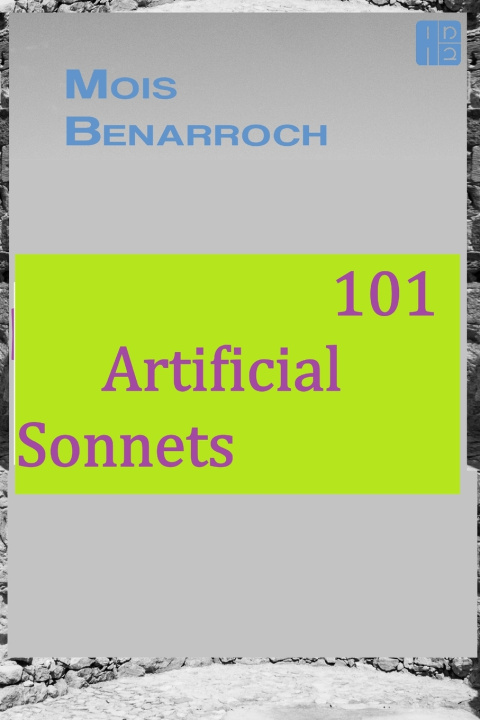
In 101 Artificial Sonnets, acclaimed Israeli poet Mois Benarroch undertakes a daring literary experiment: he deconstructs the raw, free-verse poetry of a lifetime and reconstructs it within the demanding architecture of the sonnet. The result is not merely a selection of poems but a profound transformation-a re-seeing, a re-hearing, a re-membering of the themes that have haunted his work.
Benarroch, hailed as "one of the leading Israeli poets" and "Yehuda Amichai's heir" by critics , has spent a lifetime navigating the space between worlds . Born in Tetouan in 1959, he immigrated to Israel in 1972 at the age of thirteen-an experience he describes as "moving from one planet to another" . He has published over forty books of poetry and prose, with his work translated into more than fifteen languages. His long and distinguished literary career has been recognized with the Israel Prime Minister's Prize for Literature (2008), the Yehuda Amichai Poetry Prize (2012), the Jacqueline Kahanoff Award (2021), and the A. Einstein Prize for Literature (2023) .
The sonnets in this collection distill the central tensions of Benarroch's work: the immigrant's eternal displacement, the search for a homeland that exists only in language, the pain of living between cultures, and the fierce, defiant declaration of a "one-man country" . In poem after poem, the reader encounters a poet who is "Moroccan, Spanish, Sephardi, European"-a walking country whose borders shift with every word .
Through the sonnet's fourteen lines-at once a cage and a liberation-Benarroch compresses the sprawling narratives of poems like "The Immigrant's Lament" and "Self Portrait of the Poet in a Family Mirror" into concentrated bursts of emotion and insight . The form becomes a metaphor for the poet's own life: the constraints of identity, the boundaries of language, the walls of culture, and the desperate need to find freedom within them.
Benarroch's poetry has been described as "more than poetry, they are a document. A witness of his time" . These sonnets witness everything: the trauma of leaving Morocco, the death of a brother shortly after arriving in Israel, the discrimination faced by Sephardi Jews, the absurdity of war, the loneliness of marriage, the terror of love, and the consolations of poetry itself .
Yet in this collection, Benarroch does not simply bear witness-he testifies. He speaks of "the memory of the world" held in his poetry . He writes of horses galloping out of nowhere, of viruses smaller than the mind can grasp, of bells ringing in the head that no one can stop. He writes of God and silence, of Baraka and blessing, of the desire to say goodbye to oneself and the impossibility of ever doing so.
For readers familiar with Benarroch's work, 101 Artificial Sonnets offers a fresh encounter with familiar themes. For new readers, it provides a remarkable entry point into the work of one of the most important Mediterranean Sephardi writers of our time . In these poems, Benarroch demonstrates that poetry is not just the illness but also the cure, not just the exile but also the home, not just the question but also the answer that we cannot quite hear but know is there.
As poet and critic Klaus Gerken has said: "If I had a nomination vote for the Nobel Prize, Mois Benarroch would be in the running" . *101 Artificial Sonnets* makes the case for his place in the canon-not as a poet of a single nation or language, but as a poet of the human condition, in all its displacement, longing, and hope.
Mois Benarroch was born in Tetuan, Morocco, in 1959 and immigrated to Israel in 1972. He has published over forty books of poetry and prose and has received the Prime Minister's Prize for Literature (2008), the Yehuda Amichai Poetry Prize (2012), the Jacqueline Kahanoff Award (2021), the A. Einstein Prize for Literature (2023). His work has been translated into more than fifteen languages. He lives in Jerusalem.