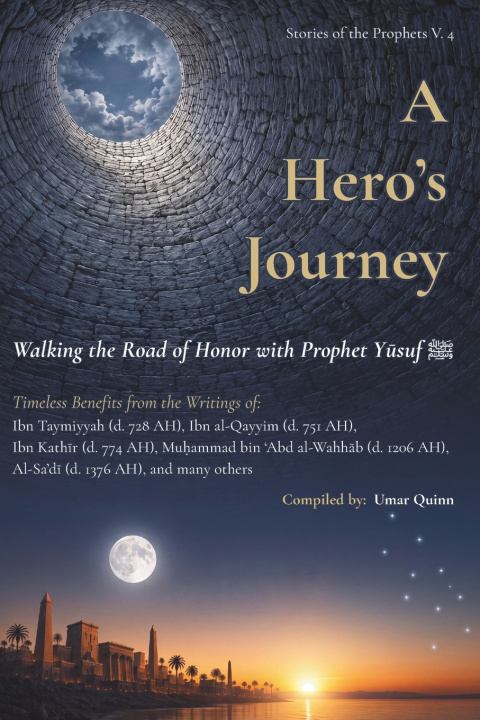
A boy is thrown into a well by his own brothers. Thirty years later he stands over the treasury of Egypt and tells them there is no blame upon them.
Between those two scenes lies a slave market, a house with locked doors, a false accusation, a prison cell, and a king who could not read his own dream. Yūsuf walked every step of it without being told where it led.
Only at the end, from the throne, looking back, could he name what had been at work the whole time: my Lord is subtle in bringing about what He wills. Luṭf is the mercy that reaches a servant from where he cannot perceive it, and lifts him to high stations by means of the very things he hates. Sūrat Yūsuf withholds that name for a hundred verses. It can only be spoken in hindsight.
What this book is
Ibn al-Qayyim wrote that this story contains more than a thousand benefits, and said he hoped to gather them one day in a book of its own. He never wrote it. Muḥammad bin 'Abd al-Wahhāb collected over three hundred and fifty points of benefit from the story. A Hero's Journey walks that road in fourteen chapters, from the dream a boy was told to keep quiet to the prayer he made at the summit of his life, asking not for more but for a good ending.
The reading is drawn from the works of Ibn Taymiyyah (d. 728 AH), Ibn al-Qayyim (d. 751 AH), Ibn Kathīr (d. 774 AH), Imām Muḥammad ibn ʿAbd al-Wahhāb (d. 1206 AH), and al-Saʿdī (d. 1376 AH), alongside al-Qurṭubī, Ibn ʿAṭiyyah, al-Biqāʿī, and more than seventy other classical works. Every citation is traced to the book in which its author wrote it.
What you will find in it
How a believer uses influence inside a system that does not share his religion, and what the limits are. Why patience that complains to Allah is still patience. What the Qurʾān means when it says most people who believe in Allah associate others with Him. How a father who lost two sons kept sending men out to look. And why the reward for fearing Allah and enduring is never wasted, though it is very often deferred.
Written for Muslims living as minorities, for converts navigating families and workplaces that are not their own, and for anyone in the middle of a trial whose wisdom they cannot yet fathom.
Volume IV of the Stories of the Prophets series, following Returning to Eden (Ādam), Before the Waters Rise (Nūḥ), and An Ummah of One (Ibrāhīm).