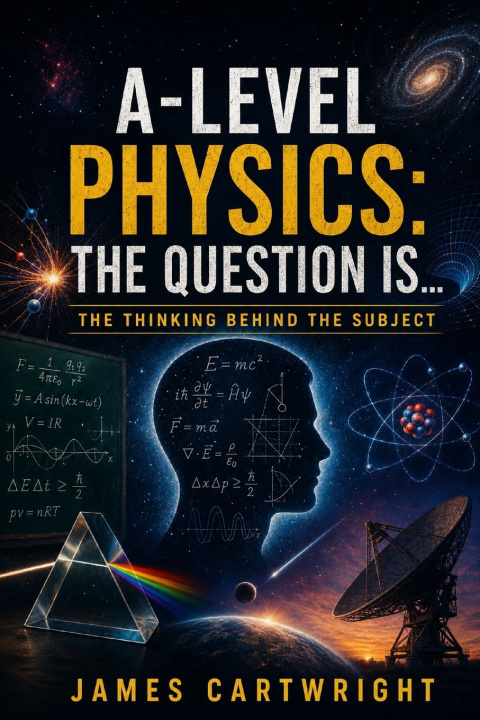
What kind of thing is a physical law, and how far can physics really take us in explaining the universe?
A-level Physics: The Question Is... sets aside formulas and past papers and asks the questions that sit underneath them. Are physical laws discoveries about how the universe actually behaves, or simply the best patterns humans have found so far? Does measurement reveal reality or help create it? Is there a limit to how far physics can go in explaining not just how the universe works, but why there is a universe at all?
Across twenty-five carefully clustered questions, this guide takes A-level Physics students beyond procedure and into genuine philosophical territory, exploring the status of physical laws, the limits of observation and measurement, the assumptions built into models and idealisations, and the boundaries of physical explanation. It also considers the relationship between mathematical equations and physical intuition, the unexpected role of anomalies in scientific discovery, and the responsibilities and inequalities that can arise when fundamental physics becomes technology. Each question is designed to provoke real classroom discussion, deepen critical appreciation of the subject, and support the kind of independent, evaluative thinking valued at the highest levels of study.
Written for students who already know how to apply the equations and are ready to ask what those equations actually tell us about the world, this book is equally suited to teachers looking for a discussion starter, or to anyone fascinated by the extraordinary ambition of physics and the limits of what it can claim to know. No prior philosophical background is required, only curiosity and a willingness to question what the syllabus usually takes for granted.
Book 3 in The A-Level Question Is... series: 25 subjects, 25 questions each, one simple goal: sharper thinking.