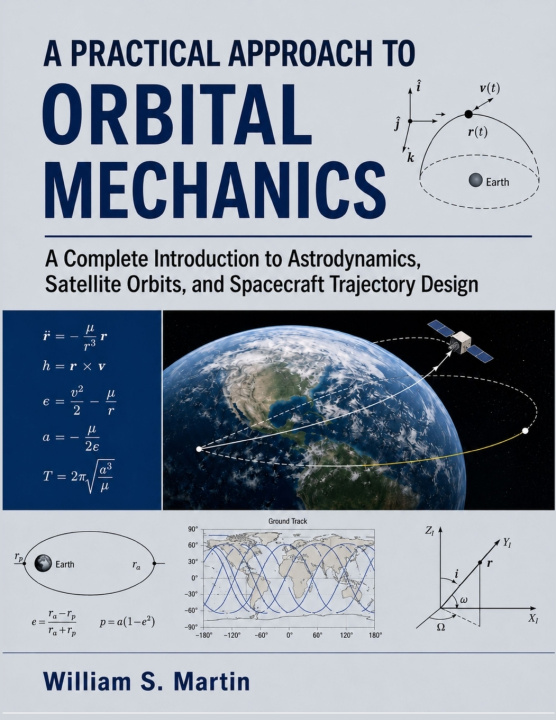
Given a spacecraft's position and velocity right now, where will it be an hour from now - and what would it cost to send it to another orbit, another vehicle, or another planet? Orbital mechanics exists to answer questions like these, and each one has a clean answer. Yet the subject has a reputation for being forbidding, and the classical texts often earn it: they state a result, assume you already know why it holds, and leave the arithmetic to someone else.
For a capable engineering student, or a working engineer who has never propagated an orbit, that gap is the whole difficulty. You can read a derivation and still be unable to set up the problem in front of you, choose the right method, and carry it to a number you can defend.
This book takes a different stance. Assuming only calculus, vector algebra, and elementary mechanics, it builds every result from first principles, states the assumptions each derivation rests on, and then - the part ordinary textbooks skip - carries a real numerical example all the way to a boxed answer, with units tracked at every step and SI units used throughout.
Inside, you will: follow complete derivations that never ask you to accept an unexplained result; work real examples solved to a final, boxed number, then test yourself on practice problems with worked answer keys; convert freely between a position-and-velocity state and the six orbital elements, and propagate an orbit forward in time; size the velocity budget for transfers, plane changes, rendezvous, and interplanetary departures; estimate how oblateness, atmospheric drag, and other perturbations move a real orbit over time; and reach for appendices of constants, planetary data, key algorithms, and reference frames whenever you need them.
Topics include the two-body problem and its conservation laws; orbit geometry, ground tracks, and the special orbits missions rely on; the classical elements and orbit description in three dimensions; position as a function of time; orbit determination from ground observations; the two-position transfer problem and launch-window plots; impulsive maneuvers and velocity budgets; relative motion, rendezvous, and proximity operations; interplanetary trajectories and the patched-conic method; gravity assists; orbital perturbations and station-keeping; and the ascent problem of reaching orbit in the first place.
Written for upper-level undergraduates meeting the subject for the first time, for early graduate students, and for practicing aerospace engineers who want a clear, worked, dependable treatment rather than a reference that assumes the answer is already known.
Open the book and begin building a practical command of orbital mechanics - the kind that lets you set up a trajectory problem, choose the right method, carry the arithmetic to a defensible number, and know exactly which assumption to question when an answer looks wrong.