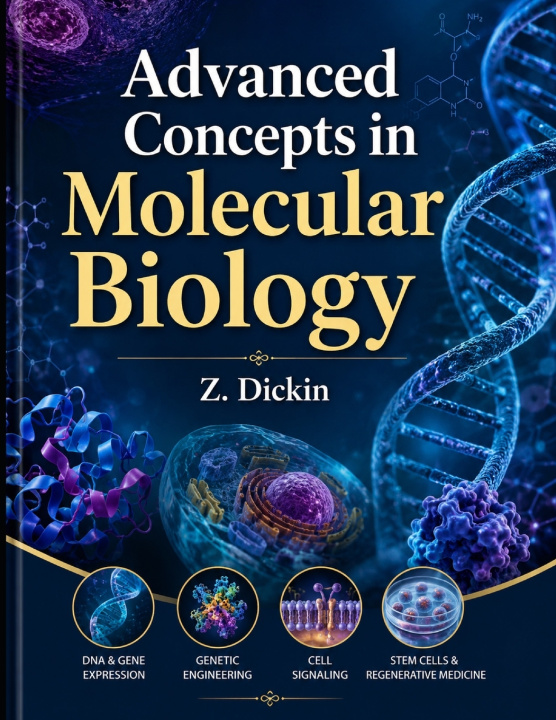
Biology has undergone a remarkable transformation over the last century. What once began as the simple observation of living organisms has now evolved into a sophisticated science capable of exploring life at the molecular level. The discovery of DNA structure, understanding gene regulation, development of recombinant DNA technology, genome sequencing, stem cell biology, and the rise of bioinformatics have completely changed the way humanity understands life itself. This book, Advanced Concepts in Molecular Biology, has been written to provide a comprehensive understanding of these modern developments in life science.
Molecular Biology stands at the center of modern scientific progress. It connects genetics, biochemistry, cell biology, biotechnology, medicine, pharmacology, computational biology, and evolutionary science. The rapid expansion of molecular biology has created new opportunities for disease treatment, agricultural development, pharmaceutical innovation, genetic engineering, regenerative medicine, and personalized healthcare. Understanding these concepts has become essential for students, researchers, educators, and anyone interested in modern biological science.
The purpose of this book is to present advanced molecular biology topics in a structured and accessible format while maintaining scientific accuracy. The chapters are designed to guide readers progressively from fundamental molecular principles toward highly advanced applications used in contemporary research laboratories worldwide. The book covers a wide range of interconnected scientific disciplines including gene regulation, epigenetics, mutation biology, genetic engineering, genomics, proteomics, bioinformatics, cell signaling, stem cell biology, regenerative medicine, and many emerging technologies that are shaping the future of biological science.
Special attention has been given to explaining scientific concepts in a logical sequence. Each chapter introduces core principles before expanding into advanced mechanisms, technological applications, and future research directions. Readers will find both theoretical foundations and practical scientific relevance integrated throughout the text.
Important modern technologies discussed in this book include:
- CRISPR Gene Editing
- Polymerase Chain Reaction
- Next Generation Sequencing
- Bioinformatics
- Stem Cell
- Gene Therapy
- Synthetic Biology
This book has been prepared especially for undergraduate and postgraduate students studying life sciences, biotechnology, microbiology, genetics, biomedical sciences, pharmacy, and related disciplines. It may also serve as a useful reference for competitive examinations, academic projects, scientific writing, and advanced biological research preparation.
Modern scientific discovery increasingly demonstrates that life is governed by highly organized molecular systems operating with extraordinary precision. Understanding these systems not only explains how living organisms function but also provides tools to solve some of humanity's greatest challenges, including genetic disease, cancer, food security, environmental sustainability, and emerging medical technologies.
Science continues to advance rapidly, and molecular biology remains one of the most dynamic and transformative scientific disciplines in the modern world. Future discoveries will undoubtedly expand our understanding far beyond current knowledge, and students learning these concepts today may become the scientists responsible for tomorrow's breakthroughs.
It is hoped that
Advanced Concepts in Molecular Biology will serve as a valuable educational resource and inspire readers to explore the fascinating molecular mechanisms that govern life itself.