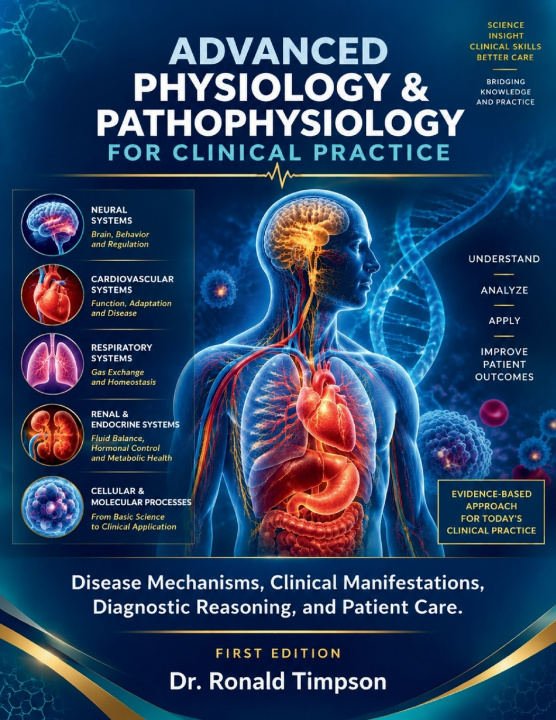
What if the gap between you and true clinical confidence isn't a lack of knowledge, but a lack of connection between the facts you've already memorized?
Have you ever stood at a bedside staring at lab values that don't add up, and felt that quiet panic of not knowing where to begin? Have you ever left a certification exam wondering if you truly understood the material, or simply recognized it long enough to guess? Have you ever explained a diagnosis and heard your own voice trail off because you could recite the "what," but not the "why"?
If that feels familiar, it isn't a failure of your intelligence or effort. It's a failure of how pathophysiology is usually taught: as thousands of disconnected facts, rather than a chain of cause and effect you can reason through.
As clinicians and educators, we've watched this play out for years, in classrooms, in rotations, and at the bedside of real patients. The clinicians who go furthest are rarely the ones who memorized the most. They're the ones who learned to ask one question: what mechanism explains this finding? That question, applied consistently across every organ system, is the foundation this textbook is built on.
This isn't another dense reference to skim once and shelve. It's built to be the book you return to again and again, before boards, before a difficult shift, before a patient who doesn't fit the pattern you expected.
Inside, you will find:
- Forty comprehensive chapters covering every major organ system, from cardiovascular and respiratory to renal, endocrine, neurologic, and reproductive
- Dedicated chapters on pregnancy, pediatrics, and geriatric physiology
- A capstone chapter on reasoning through complex, multi-system patients
- Hundreds of full-color diagrams and mechanism flowcharts that make abstract processes visible
- 300+ comparison tables untangling look-alike conditions clinicians confuse under pressure
- A real clinical case opening every chapter, revisited once you have the mechanism to explain it
Why does this matter? Because the gap between knowing facts and reasoning through a patient determines outcomes: your exam results, your confidence in practice, and the care your patients receive.
You may wonder if you truly need another textbook. Perhaps you already own several, and none fully delivered. That concern is fair, and it's exactly why this book was built differently: around mechanism instead of memorization, tested against one question: does this actually help you think through a real patient?
This book was built for you if:
- You're an NP or DNP student who wants to understand disease, not just recognize its name
- You're a PA or nursing student tired of forgetting material the week after the exam
- You're a practicing clinician who wants a dependable reference for patients who don't read the textbook first
- You value reasoning that transfers to unfamiliar presentations, not memorization that expires after the test
There is no version of practice where every patient fits a remembered pattern. The real version requires reasoning that holds up when the pattern breaks. This book was written to build exactly that clinician.
Scroll up and click "Buy Now." The patients you'll one day stand in front of are counting on the clinician you become between now and then.