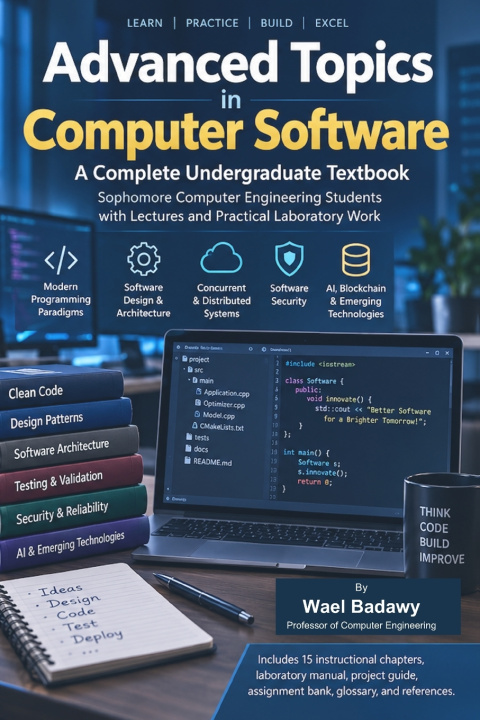
This book is written for students who already know basic programming and introductory software engineering, and who are ready to see software as an engineered system. The chapters introduce modern programming paradigms, architecture, verification and validation, performance, security, AI-assisted development, and blockchain applications. The tone is practical: every concept should help students design, build, test, review, optimize, secure, or explain real software.
The book can be used as the main resource for a one-semester course. Each chapter includes learning objectives, core concepts, examples, a laboratory activity, review questions, applied exercises, a mini case study, and suggested readings. The final project integrates the whole course.
Students should read each chapter before lecture, complete the review questions after lecture, and use the applied exercises to prepare for laboratories and exams. Laboratory work should be treated as engineering evidence: students are expected to show what they built, how they tested it, what they measured, and what limitations remain.
Instructors may use the chapters in sequence for a 15-week semester or combine Chapters 2-5 into a programming paradigms module, Chapters 6-9 into an architecture module, Chapters 10-13 into a quality and security module, and Chapters 14-15 as an emerging technologies module. The semester project should begin early, because the strongest submissions demonstrate progressive improvement rather than a rushed final implementation.
The model responses illustrate defensible answers rather than unique solutions. Study answers and practice responses follow their prompts. Each chapter also includes a model laboratory answer and an analysis of its mini case study. Laboratory examples supply concrete artifacts, contracts, tests, and trade-offs. Proposed benchmarks are procedures to carry out; illustrative targets and calculated examples are not claimed measurements from a deployed system. Reference implementations are small teaching examples whose scope and limitations accompany the code.