An agent that has run clean for six weeks is not a reliable agent. It is an agent whose failure modes you have not met yet.
AI agents are moving into production and failing there in ways the demos never showed. A support bot invents a policy that never existed and its company is held to it. A coding agent deletes a live database during a change freeze. A zero-click email turns an AI assistant into an exfiltration tool. Behind each of these incidents is a missing piece of architecture.
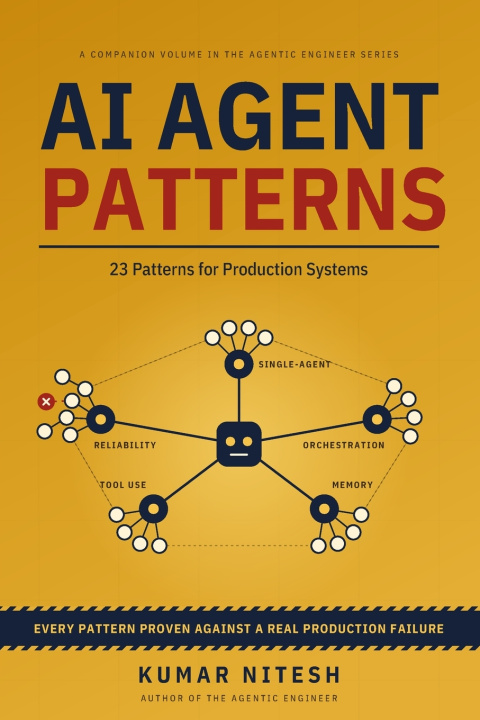
AI Agent Patterns is a catalog of 23 patterns, in the Gang of Four tradition, for building agentic systems that survive contact with production. Every pattern is documented architecture first: the problem it solves, the forces pulling against each other, what it costs, runnable Python, the anti-pattern it prevents, and, in most chapters, a real production failure that shows what happens without it.
Most patterns are anchored to a failure someone already paid for
- A pipeline of individually correct components that bought houses at the wrong price and wrote down more than $540 million
- Forty-five minutes of unmetered automated trading that cost more than $460 million
- A support agent that invented a login rule, and the cancellations that followed
- A command-line assistant whose file operation silently failed, after which it overwrote a user's work
- A zero-click prompt injection that pulled data out of an AI assistant with no user action at all
Each story is checked against primary sources: vendor postmortems, regulatory filings, a tribunal decision, CVE records, and security researchers' disclosures. Each one sits at the end of its chapter as the reason its pattern exists.
The catalog
- Single-agent: ReAct, Plan-and-Execute, Reflection, Chain-of-Thought Decomposition
- Orchestration: Supervisor/Router, Hierarchical Delegation, Sequential Pipeline, Swarm
- Memory and state: Context Window and Compaction, Long-term Vector Memory, Episodic Memory, Shared Blackboard
- Tool use: Tool Router, Agentic RAG, Code-Execution Sandbox, Control Plane as a Tool
- Reliability and security: Human-in-the-Loop Checkpoint, Critic/Verifier, Evaluation Harness, Retry with Backoff and Durable Execution, Cost/Latency Governor, Prompt Injection Guardrail, Least-Privilege Tool Scoping
Written for engineers who ship
There is no LLM primer here. The book assumes a strong engineer who has not necessarily built agentic systems, and hands you the vocabulary of the recurring problems instead: control flow, orchestration, memory, tool use, and the reliability and security work that separates a demo from a system. Code is Python, given framework-agnostic first and then in LangGraph, LangChain, and CrewAI. Frameworks churn. The patterns are the part that lasts.
It opens with a decision tree that runs from "should this even be an agent?" to the pattern your problem actually calls for, and closes with a failure story index, a framework mapping table, a quick-reference card, and a glossary.
A standalone volume in The Agentic Engineer series.