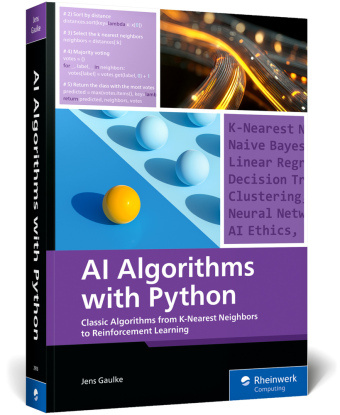
What really happens when you call model.fit()? Open the black box of machine learning and find out for yourself by building classic AI algorithms using this practical guide! You'll implement k-nearest neighbors, Naïve Bayes, linear and logistic regression, decision trees, k-means clustering, support vector machines, neural networks, and reinforcement learning-all from scratch in Python. Apply each method to real data, measure its performance, and then deliberately break it to discover its limits!
a. Math and Data Science Foundations
Get an intro to the math you need-linear algebra, statistics, probability, and gradient descent-explained with code instead of proofs. Then learn the data science workflow: clean and explore data with pandas, engineer features, and evaluate models with metrics such as accuracy, precision, recall, and RMSE.
b. Algorithms from Scratch
Work through one algorithm at a time, from k-nearest neighbors and Naïve Bayes to support vector machines, neural networks, and Q-learning. Build each one in simple Python, apply it to real data in Jupyter Notebook, and then implement it professionally with scikit-learn.
c. Limitations and AI Ethics
Push each algorithm into situations it can't handle-outliers, poor scaling, imbalanced classes, overfitting-to find out exactly why it fails. Understand the responsibility that comes with building AI models, and learn about bias, transparency, and the importance of keeping a human in the loop.
Highlights:
- Mathematics for machine learning
- Data science and evaluation metrics
- k-nearest neighbors (kNN)
- Naïve Bayes
- Linear and logistic regression
- Decision trees
- k-means clustering
- Support vector machines (SVMs)
- Neural networks
- Reinforcement learning
- Pygame simulations
- AI and ethics