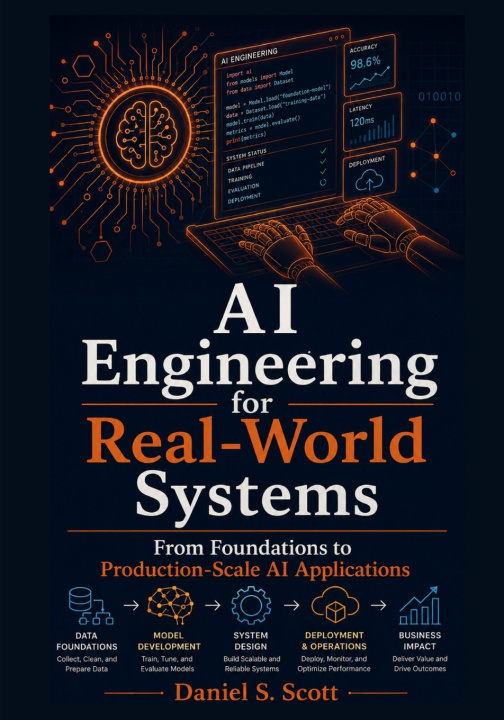
AI Engineering for Real-World Systems: From Foundations to Production-Scale AI Applications
Building an AI application that works in a demo is easy. Building one that performs reliably in the real world is where the true challenge begins. Many developers and organizations struggle with the same problems: unpredictable AI responses, hallucinations, poor system architecture, rising operational costs, and the difficulty of turning powerful foundation models into dependable products.
AI Engineering for Real-World Systems provides a practical framework for designing, developing, and deploying production-ready AI applications that move beyond simple chatbot experiments. This book explains how modern AI systems are engineered by combining foundation models with effective architecture, context management, retrieval systems, tools, memory, evaluation strategies, and reliable deployment practices.
Rather than focusing only on models, this book teaches the engineering principles required to build complete AI-powered systems that can operate efficiently at scale. Readers will learn how to think like an AI engineer by understanding how different components work together to create intelligent, reliable, and maintainable applications.
Inside this book, you will learn how to:
Understand the architecture behind modern AI applications and how models fit into larger software systems.
Design effective AI workflows using prompts, context engineering, retrieval systems, and external tools.
Build reliable AI applications that reduce hallucinations and improve response accuracy.
Understand tokens, context windows, inference behavior, and the practical limitations of foundation models.
Develop Retrieval-Augmented Generation (RAG) systems that connect AI models with trusted knowledge sources.
Design AI agents and workflow systems capable of performing complex tasks.
Implement memory systems that enable personalized and context-aware experiences.
Create structured outputs that make AI responses predictable and usable in production environments.
Monitor AI applications using observability, evaluation, and performance tracking strategies.
Identify common AI system failures and apply engineering solutions to improve reliability.
Balance accuracy, speed, scalability, and cost when deploying AI applications.
Whether you are a software developer expanding into AI, a technical professional building intelligent applications, an entrepreneur creating AI-powered products, or an engineer preparing for the future of software development, this book provides the practical knowledge needed to design AI systems that work beyond the prototype stage.
The future of software is not only about creating smarter models. It is about engineering smarter systems around those models.
Start building AI applications designed for real-world performance. Get your copy of AI Engineering for Real-World Systems: From Foundations to Production-Scale AI Applications today and develop the skills needed to create reliable, scalable AI solutions.