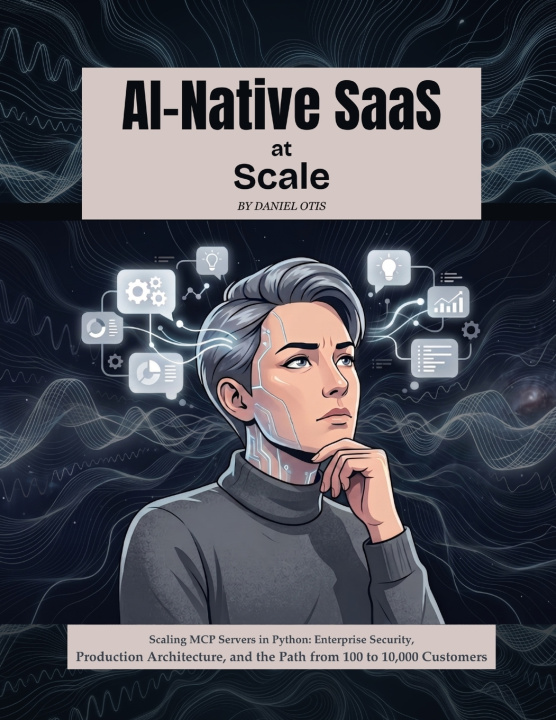
You didn't build it. Now you have to scale it.
Book 1 was about building an MCP server. This book is about what happens after it works - real customers, real load, and a founder who has moved on. If you operate an AI-native SaaS or a Model Context Protocol server in production - especially one you inherited - this is your field guide to scaling it.
Marcus Okafor didn't build Nasay. He bought it: a running MCP server, 127 paying customers, six months of runway, and one engineer - himself. He inherited every decision without the context behind it, which is the ordinary condition of almost everyone who runs software they did not write. The context you're missing isn't lost - it hasn't been measured yet.
Across fifteen chapters and one continuous story, you'll turn an inherited server into a production system that survives enterprise buyers, real concurrency, and multi-tenant scale - then price it in a conversation you can actually win.
What you'll learn
- Read a server you didn't write - a five-category structural audit, a contracts inventory, and how to find the one constraint that actually binds.
- Pass the enterprise gate - SOC 2 without the theater, per-tenant SSO and OAuth authorization, deprovisioning guarantees, and the security-review questions that expose your architecture rather than your docs.
- Deepen the tool surface - consolidate a sprawling tool set, tell batching apart from workflows, and design tools an AI agent actually selects correctly.
- Survive real load - why the session, not the request, is your unit of scale; how to find your binding constraint before it finds you; and why adding servers can make things worse.
- Cache without breaking tenant isolation - caching for connections instead of latency, keying by tenant, and treating invalidation as a correctness guarantee.
- Find out what a customer actually costs - a four-part cost vector, usage-based metering as a contract, and pricing that survives your own roadmap when per-seat stops working.
- Go upmarket without becoming a consultancy - why every enterprise request is a request to un-share, and how to say yes without forking your product forever.
- Live in the ecosystem - when your six tools are six of sixty in a customer's host, the integration that happens without you, and the case for honest tool descriptions.
Who it's for
Founders, staff and senior engineers, and technical leads running an AI-native SaaS or MCP server in production - especially anyone who inherited one. Examples are in Python with FastMCP, but the patterns are protocol-level and architectural; they transfer to any language or framework.
Inside the book
- 15 chapters in five Parts - Inherit, Harden, Deepen, Scale, Expand
- One continuous, worked case study rather than disconnected snippets
- 45 practical exercises with a full solutions appendix
- Quick-reference appendices: protocol at scale, tool surface, operational patterns, and a glossary.
The AI-Native SaaS Series, Book 2. Reads standalone; pairs with Book 1 for the full build-to-scale arc.
Measure first. Then commit. Then scale.