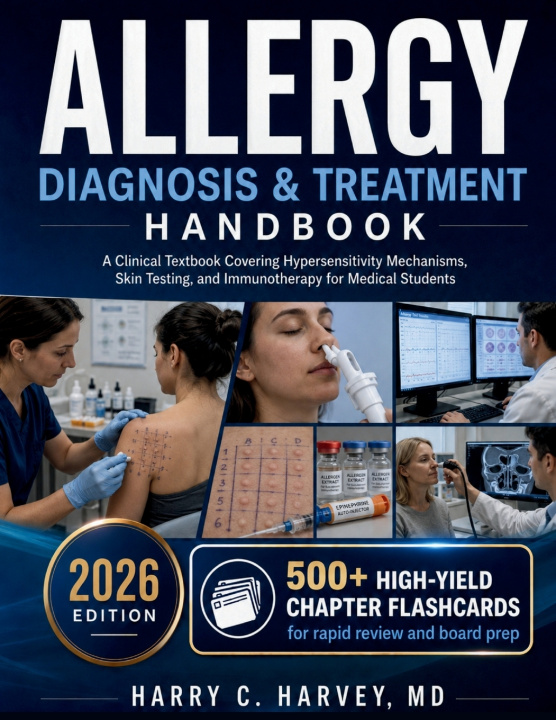
A patient sits in your chair holding a list of twelve medications, presenting with sudden urticaria after dinner three nights in a row, and the answer matters before the next prescription is written.
When allergic disease is treated with empirical avoidance, broad-spectrum substitutions, and reflexive antihistamines, the cost compounds - missed alpha-gal syndrome, mislabeled penicillin allergy driving worse infection outcomes, peanut-allergic adolescents without autoinjectors, severe asthma managed without phenotype assessment.
This handbook delivers the mechanism-driven clinical reasoning that transforms how you evaluate, diagnose, and treat allergic disease across every organ system and clinical setting.
Inside this book:
• Mechanism-first diagnosis - apply the four classes of hypersensitivity to direct the right test for the right reaction, every time
• Distribution-based dermatology - recognize nickel, paraphenylenediamine, urushiol, and rubber accelerator contact patterns at sight before patch testing confirms
• GINA-aligned asthma management - execute Track 1 and Track 2 stepwise treatment and select among six approved biologics by phenotype and biomarker profile
• Anaphylaxis with authority - administer epinephrine to the anterolateral thigh on recognition, manage refractory presentations, and identify hereditary alpha tryptasemia in recurrent severe reactions
• Penicillin de-labeling protocols - risk-stratify with PEN-FAST, perform direct oral challenge in low-risk patients, and clear the label that has restricted antibiotic choice for years
• LEAP-era food allergy prevention - implement early peanut introduction, identify alpha-gal syndrome by its delayed pattern, and counsel families on oral immunotherapy options
• Disease-modifying immunotherapy - select candidates, execute build-up and maintenance protocols, and prevent the asthma development that follows untreated allergic rhinitis
Written for medical students transitioning to clinical training, residents, fellows, internists, family physicians, pediatricians, nurse practitioners, physician assistants, and practicing allergists.
Order this handbook and bring mechanism-driven clinical reasoning to every patient with allergic disease who walks through your door.