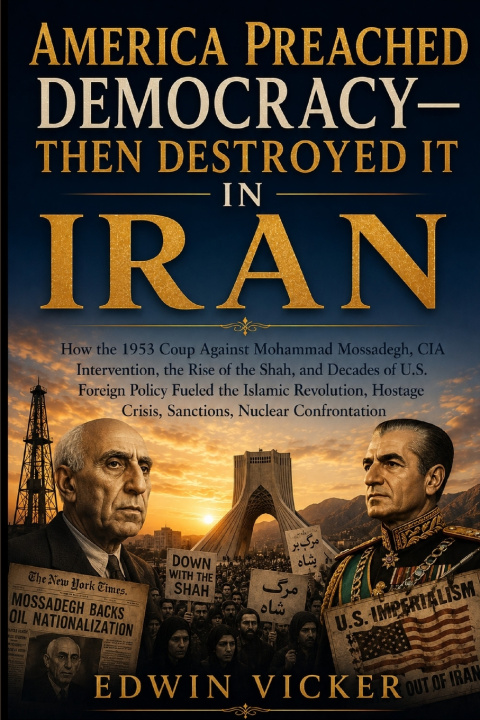
America Preached Democracy. Then Came Iran.
In the years after World War II, the United States presented itself as a defender of freedom, self-government, and democracy. Yet in Iran, American power became entangled in one of the most consequential political interventions of the twentieth century.
In 1953, Iranian Prime Minister Mohammad Mossadegh stood at the center of a confrontation involving democracy, nationalism, oil, Britain, the United States, the Iranian monarchy, and the escalating fears of the Cold War. His government's decision to nationalize Iran's oil industry transformed a domestic political struggle into an international crisis.
AMERICA PREACHED DEMOCRACY-THEN DESTROYED IT IN IRAN examines how that crisis unfolded and why Washington ultimately supported the overthrow of Mossadegh.
But this is more than a story about one coup.
It is an examination of the difficult contradiction between America's democratic ideals and the strategic calculations that shaped its foreign policy. It explores the struggle over Iranian oil, Britain's determination to protect its interests, Washington's fear of communist expansion, the role of the CIA, the Iranian political forces that participated in the crisis, and the rise of an increasingly powerful monarchy after Mossadegh's removal.
Inside This Book
- The political and economic crisis that brought Mossadegh and the oil nationalization struggle to the center of international attention
- Why Britain opposed Iran's attempt to take greater control of its oil resources
- How Cold War fears influenced American decision-making
- The development and execution of the 1953 coup against Mossadegh
- The roles played by American and British intelligence, the Shah, Iranian political factions, and military figures
- How the coup altered Iran's political trajectory
- Why the events of 1953 continued to shape Iranian attitudes toward the United States for decades
The 1953 overthrow did not simply remove a prime minister. It changed the relationship between Iran and the Western powers and helped create political consequences that would echo through the Shah's rule, the Iranian Revolution of 1979, and the troubled relationship between Tehran and Washington that followed.
At the heart of the story is a question that reaches far beyond Iran:
What happens when a nation that publicly champions democracy decides that strategic interests are more important than the democratic process it claims to defend?
Drawing together the political, economic, and Cold War dimensions of the crisis, this book offers readers a compelling examination of one of the pivotal turning points in modern Middle Eastern history-and the long shadow it continues to cast over international politics.