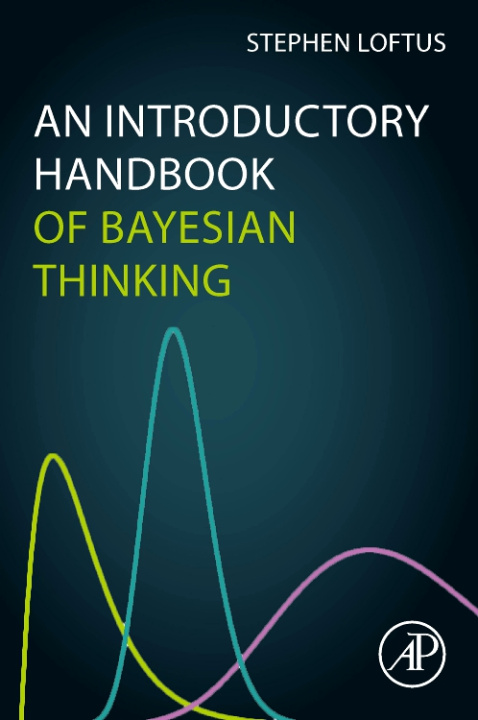
As Bayesian techniques become more common across a variety of fields, it becomes important for experts in those fields to understand those methods. An Introductory Handbook of Bayesian Thinking brings Bayesian thinking and methods to a wide audience beyond the mathematical sciences. Appropriate for students with some background in calculus and introductory statistics as well as for non-statisticians with sufficient mathematical background, the text uses a specific methodology to illustrate Bayesian ideas. Focusing on in the first half, the book builds up the basic rules of probability and random variables. From there, this valuable introduction transition to the idea of likelihoods and switching to the Bayesian paradigm of thinking. The second half of the text focuses on Bayesian models for specific situations, including hierarchical models for the mean and precision, regression, binomial/ordinal regression, and more. Throughout, real datasets are used to illustrate the models and their results. Additionally, readers are taught how to code up their models using the statistical software R—a basic introduction of which is provided in an Appendix. Utilizes real datasets to illustrate Bayesian models and their results Guides readers on coding Bayesian models using the statistical software R, including a helpful introduction and supporting online resource Appropriate for an undergraduate statistics course, as well as for non-statisticians with sufficient mathematical background (integral and differential Calculus and an introductory Statistics course)Covers any more advanced topics which readers may not be familiar with—such as the basic idea of vectors and matrices—as much as needed in order to foster understanding of core concepts