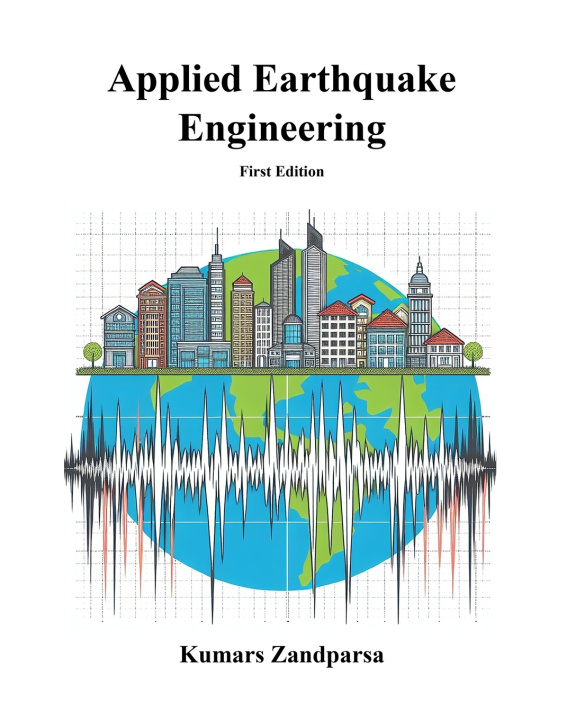
Könyv Applied Earthquake Engineering Kumars Zandparsa

Applied Earthquake Engineering

Szerző: Kumars Zandparsa
Nyelv: Angol
Kötés: Puha kötésű
Kiadó: Qtech
Elérhetőség: Beszállítói készleten
Küldés 10-18 napon belül
19 598 Ft
This book aims to provide a comprehensive understanding of the application of earthquake engineering...

Információk a könyvről

Nyelv
Angol
Kötés
Könyv - Puha kötésű
Kiadva
2025
oldal
398
EAN
9798991163514
Enbook ID
53234161
Kiadó
Súly
787
Méretek
203 x 254 x 21

Teljes leírás

This book aims to provide a comprehensive understanding of the application of earthquake engineering, focusing on determining lateral seismic loads based on modal vibration theory and relevant codes (ASCE7-22). It is designed to serve as both a textbook for graduate and undergraduate courses in earthquake engineering and a resource for self-study.
The course content is organized into eight chapters: seven based on theoretical foundations and one focused on code applications. In high seismic zones, this subject is in great demand. From my time as a student searching for the ideal earthquake engineering book to my current experience teaching the course, I have found no text that fully satisfies the way that I thought might be the best way to transfer this course to students.
Multiple earthquakes loading cycles will be applied with an intensity that might drive the structure to a nonlinear range of response. Earthquake nonlinear analysis is beyond the scope of this textbook.
The book is divided into four main parts:
Part One (Chapters 1 to 3): Preparation for modal and time history analysis and reviews:

  • Degrees of freedom and stiffness (two- and three-dimensional frames and continuous structures)
  • Mass, mass moment of inertia, and mass of continuous structures
  • Damping and influence matrix (two- and three-dimensional frames)
Part Two (Chapter 4): Determining structure physical properties such as natural frequencies and mode shapes.
Part Three (Chapters 5 to 7): Is covering:
  • Response history analysis (RHA) for two- and three-dimensional frame structures
  • Response spectrum analysis (RSA) for two- and three-dimensional frame structures
  • ASCE7-22 design response spectrum.
  • Modal response combinations
Part Four (Chapter 8): Is code-based Application.
  • Equivalent static lateral force based on ASCE7-22