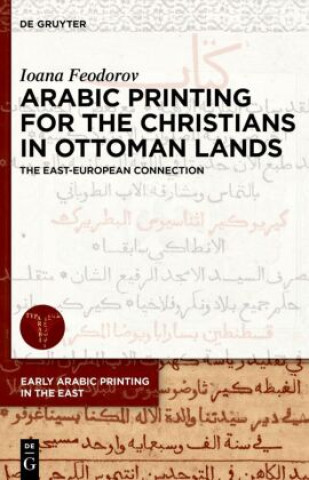
In Eastern Europe and the Ottoman Levant, Arabic printing began with the association between the scholar and printer Antim the Iberian, later a metropolitan of Wallachia, and Athanasios III Dabbas, patriarch of the Church of Antioch twice, metropolitan of Aleppo when sojourning in Bucharest. They printed in Arabic and Greek, for the first time, the Book of the Divine Liturgies (Snagov 1701) and the Horologion (Bucharest 1702). With printing tools and knowhow from Wallachia, Dabbas founded in 1705 in Aleppo the first Arabic press on Ottoman territory. After the 1724 division in the Church of Antioch, a new press founded by Abdallah Za er for the Arabic-speaking Greek Catholics opened in Deyr el-Suweyr (Lebanon). Active in 1752-1753, the Arabic press at the Orthodox church of St George in Beirut produced liturgical books that preserved elements of the Aleppo books and were reprinted for decades. This book tells the story of the first Arabic presses in the Ottoman realm, which provided church books to the Arabic-speaking Christians irrespective of their confession, owing to the diligence of major hierarchs like Sylvester of Antioch and Sofronios II of Constantinople, and the financial support of East European rulers.