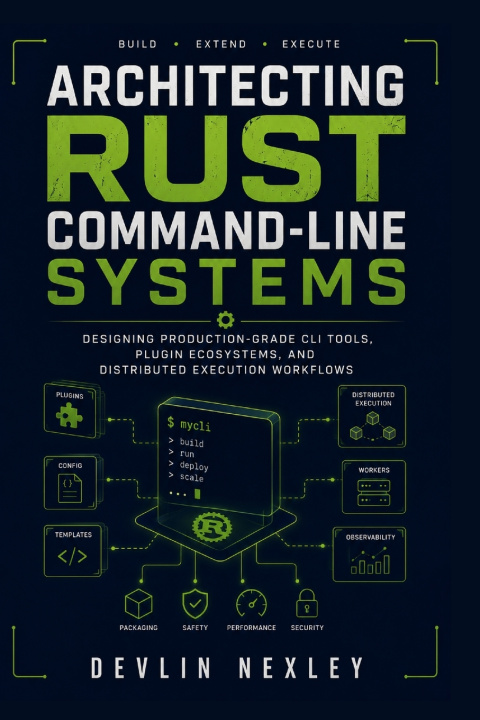
Architecting Command-Line Rust Systems is a deep technical exploration of command-line software as a systems engineering discipline. Rather than treating CLI applications as simple utilities, this book examines how modern command-line systems are designed, built, extended, and operated as production-grade infrastructure components using Rust.
As organizations increasingly rely on automation, platform engineering, developer tooling, and infrastructure orchestration, command-line applications have become critical interfaces between engineers, services, operating systems, and deployment environments. Building these systems requires more than knowledge of language syntax or argument parsing libraries. It demands an understanding of process architecture, execution models, stream-oriented computing, concurrency, filesystem behavior, packaging strategies, observability, and long-term maintainability.
This book takes an architecture-first approach to Rust command-line development, focusing on the internal mechanisms that govern performance, reliability, extensibility, and operational correctness. Through detailed examinations of Cargo, process management, CLI parsing systems, asynchronous execution, plugin architectures, configuration resolution, telemetry pipelines, and cross-platform distribution, readers will gain a systems-level perspective on designing robust command-line ecosystems.
Topics include:
Command-line systems as process-oriented execution architectures
Rust's systems programming model for infrastructure tooling
Cargo internals, dependency orchestration, and build pipelines
Process lifecycle management and operating system interaction
Command parsing architectures and command dispatch systems
stdin, stdout, and stream-based data processing patterns
Error handling, diagnostics, and resilient execution strategies
Structured logging, tracing, telemetry, and observability
Filesystem semantics, state management, and data integrity
Concurrency, asynchronous runtimes, and workload orchestration
Cross-platform development and operating system compatibility
Binary optimization, packaging, and cross-compilation workflows
Plugin architectures and extensible CLI ecosystems
Long-term maintainability, versioning, and tooling evolution
Written for experienced software engineers, systems programmers, platform engineers, infrastructure architects, and advanced Rust developers, this book emphasizes architectural reasoning, implementation tradeoffs, and production engineering practices rather than introductory tutorials. Readers will learn how to design command-line systems that scale from individual tools to large, extensible ecosystems capable of supporting modern software platforms and operational environments.
Whether you are building developer tools, automation frameworks, infrastructure utilities, platform engineering workflows, or enterprise command-line ecosystems, Architecting Command-Line Rust Systems provides the technical foundations and architectural patterns required to engineer reliable, high-performance command-line software in Rust.