Calls for rethinking architecture as a way of renegotiating our encounter with the world, taking into account the role of love and desire in all human making.
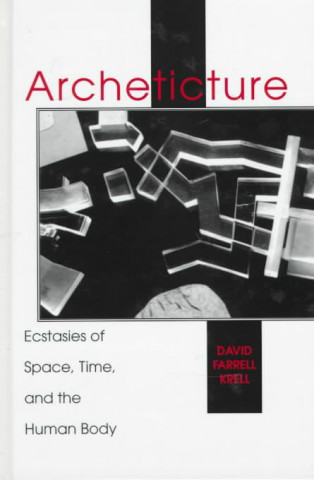
In this book, David Farrell Krell challenges contemporary and traditional theories of architecture with archeticture-spelling it new, by design. The thesis of the book is that the heart of the word architecture, the Greek root tec-, can be traced back to an earlier and more pervasive root, tic-. The verb tiktein means "to love," "to engender," "to reproduce." In the course of Western history, however, that older root disappeared under the debris of discarded techniques, technologies, architectonics, and architectures, all of them insisting on technical mastery, technological power, and architectonic solidarity. Yet what would happen to the confidence we place in technique if we realized that its dominion is based on a kind of oblivion-an oblivion of the materials, places, situations, and human bodies that not even the mightiest technician can thoroughly dominate, but that he or she must love?
The opening chapter of Archeticture proposes a new reading of Plato's Timaeus, the seminal work in Western philosophy on the architecture of the universe and the human body. It pays close attention to the figures of Chaos, Necessity, and khora in Timaeus, arguing that the Demiurge is less a divine craftsman or technician than a lover and a father-admittedly, a father of an awkward and forgetful sort. Among the things the Demiurge forgets to acknowledge are the elements, spaces, and places, the materiality and the spatiality, in which he finds himself-but which he does not master. Chapter 2 moves from Plato to the modern and contemporary philosophers Kant, Hegel, and Heidegger. It sees in the projects of these thinkers a growing liberation of choric space from time, culminating in an ecstatic interpretation of human spatiality. Yet ecstatic spatiality is anything but familiar; it is essentially unhomelike and uncanny. Chapter 3 offers a series of archetictural sections-as opposed to architectural plans or elevations-of Freud and Heidegger on the theme of the uncanny and unhomelike, das Unheimliche. The fourth and final chapter turns to three recent thinkers who, in very different ways, introduce uncanny human bodies into unhomelike spaces: Merleau-Ponty, Bataille, and Irigaray.