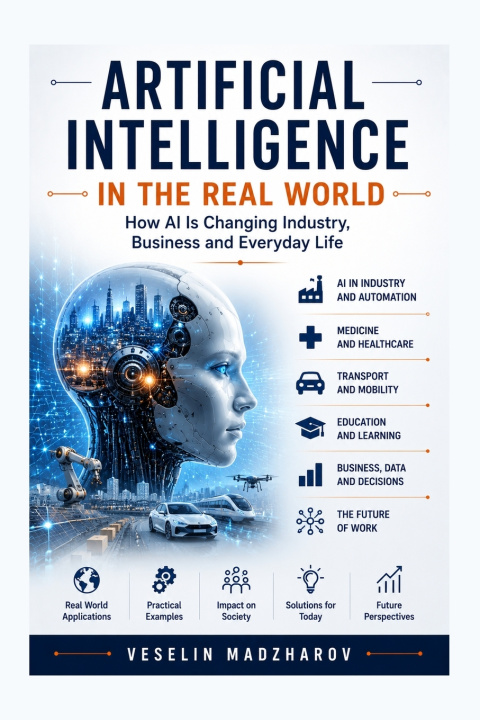
Artificial intelligence is no longer waiting in the future. It is already inside factories, hospitals, power systems, vehicles, banks, smartphones, warehouses, and the digital services people use every day.
But what does AI actually do in the real world-and when is it genuinely better than traditional technology?
Artificial Intelligence in the Real World cuts through the hype and shows how modern AI is being used where results matter: production lines, predictive maintenance, machine vision, industrial robots, energy management, healthcare, transport, logistics, finance, cybersecurity, education, agriculture, smart cities, entertainment, space exploration, and everyday life.
This is not a book about science-fiction machines, artificial consciousness, or exaggerated promises. It is a practical guide to AI as it really exists: a powerful engineering and business tool that predicts, analyzes, recommends, optimizes, and assists-but also fails when the data is poor, the process is unstable, or the risk is too high.
Inside, you will discover:
• How AI moved from research laboratories into ordinary products and industrial systems
• Why prediction is the foundation of most useful AI applications
• How predictive maintenance can identify machine problems before breakdowns occur
• How machine vision detects defects that traditional inspection may miss
• Where AI improves robotics, energy systems, transport, medicine, business, and logistics
• Why PLCs, PID controllers, fixed rules, and deterministic automation are still often the better choice
• How AI systems move from prediction to decision-and why human responsibility must remain in control
• What makes an AI project useful, reliable, affordable, and safe
• Where AI fails, drifts, produces false results, or creates unnecessary complexity
• How human expertise and artificial intelligence can work together instead of competing
Every major application is explained through a clear structure: the real problem, the traditional solution, the AI-based approach, practical examples, advantages, limitations, and the conditions required for success.
Written for engineers, technicians, managers, business owners, students, workers, and curious readers, this book makes artificial intelligence understandable without burying the reader in mathematics or programming theory.
Whether you work with industrial machines, manage a business, follow new technology, or simply want to understand the systems shaping modern life, this book will give you a realistic view of what AI can do-and what it cannot.
AI is not magic. It is not automatically intelligent, reliable, or necessary. It is a tool.
And the organizations that understand when to use it-and when not to-will be the ones that benefit most.
Artificial Intelligence in the Real World is your practical guide to the technology already changing industry, business, and everyday life.