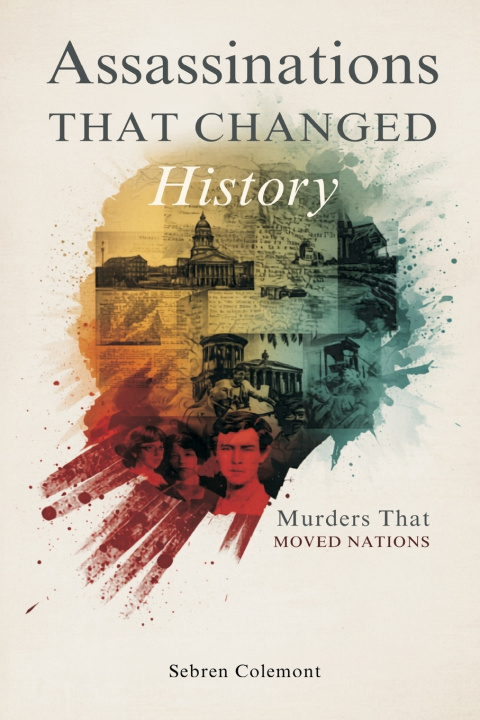
Assassinations That Changed History is a gripping work of narrative history about political murders that did more than remove powerful individuals-they changed the direction of states. Moving from Julius Caesar and Thomas Becket to Abraham Lincoln, Tsar Alexander II, Franz Ferdinand, Gandhi, Rabin, Indira Gandhi, Anwar Sadat, and Benazir Bhutto, the book shows how an assassination can trigger war, harden a regime, derail reform, fracture succession, or reshape borders for generations. It is not interested in melodrama for its own sake. Its real subject is consequence.
What gives the book its strength is the way it treats each killing as both a human event and an institutional shock. A pistol, a knife, a bomb, a failed security detail, a funeral, a hurried proclamation, a disputed succession, emergency laws, retaliatory arrests, altered borders: the chain from murder to political aftermath is traced with unusual clarity. The book repeatedly shows that assassination is never only about the assassin and the victim. It is about the systems around them-courts, armies, police, parties, newspapers, and publics-suddenly forced to decide what the death will mean.
For readers interested in political assassination, world history, political violence, and the hidden mechanics of state power, this is a strong and highly usable book. It explains not just who died and how, but why some killings became genuine turning points while others faded into spectacle. Serious but readable, it connects motive, plot, aftermath, and institutional consequence in a way that makes each case feel immediate without losing the larger historical argument.