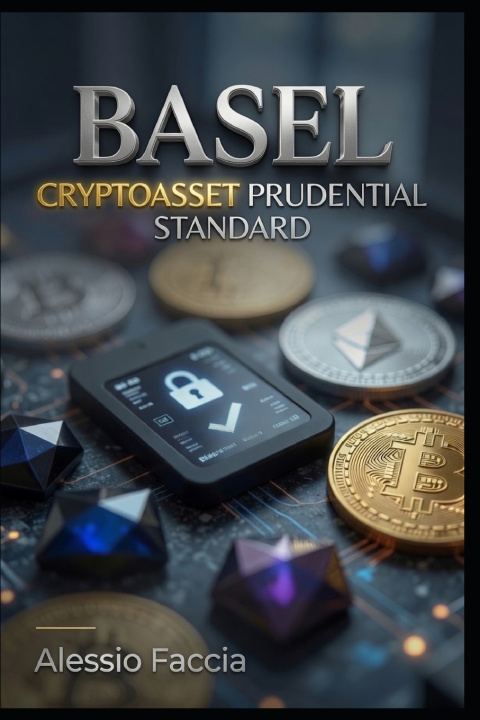
Basel Cryptoasset Prudential Standard is a practical professional guide to bank capital treatment, stablecoin eligibility, tokenised assets, cryptoasset exposure limits, Pillar 3 disclosure, audit evidence, and implementation planning under Basel SCO60.
Banks, risk officers, compliance teams, auditors, finance teams, treasury functions, legal advisers, board members, and digital asset professionals face a new prudential test from 1 January 2026. Cryptoasset activity now requires more than product approval, technology confidence, or market liquidity. It requires documented classification, legal evidence, capital mapping, liquidity analysis, operational risk controls, wallet governance, data lineage, and supervisory readiness.
This book explains Basel SCO60 through a structured bank implementation lens. It covers Group 1a tokenised traditional assets, Group 1b stablecoins, Group 2a cryptoassets, Group 2b cryptoassets, conservative risk weights, credit risk treatment, market risk treatment, counterparty credit risk, CVA risk, leverage ratio, large exposure treatment, liquidity risk, operational risk, ICAAP integration, and Pillar 3 disclosure.
The book gives detailed guidance on tokenised traditional assets and the same-risk requirement. It shows why a tokenised bond, tokenised claim, tokenised deposit, or tokenised security must prove legal and economic equivalence before a bank applies favourable treatment. It also explains stablecoin classification in strict prudential terms, including stabilisation mechanisms, redemption rights, reserve asset quality, issuer supervision, reserve evidence, valuation checks, and independent attestation.
Basel SCO60 rewards evidence, not labels. A stablecoin does not qualify through price stability alone. A tokenised asset does not qualify because it carries the name of a traditional instrument. A cryptoasset hedge does not reduce capital unless it satisfies Basel recognition criteria. A wallet balance does not prove ownership unless the bank links it to legal rights, custody terms, accounting records, and reconciled operational evidence.
Readers will find clear coverage of bank governance, senior management responsibility, supervisory review, documentation standards, cryptoasset exposure registers, wallet records, internal audit testing, control failures, exception logs, corrective action plans, policy updates, system configuration, staff training, and board reporting.
The book also supports Amazon Kindle readers searching for practical resources on Basel cryptoasset regulation, digital asset banking rules, stablecoin prudential treatment, tokenised asset capital requirements, cryptoasset risk management, regulatory reporting, and banking compliance.
Ideal readers include:
risk managers working on digital assets,
prudential reporting teams preparing SCO60 implementation,
internal auditors testing cryptoasset controls,
compliance officers drafting policy updates,
finance teams mapping accounting and regulatory treatment,
legal advisers reviewing ownership and redemption rights,
board members supervising cryptoasset risk appetite,
consultants advising banks on digital asset regulation,
students and professionals studying Basel banking regulation.
Basel Cryptoasset Prudential Standard treats SCO60 as a bank operating model, not a narrow capital rule. It links asset classification to capital, liquidity, leverage, large exposure management, disclosure, audit, and governance. It gives readers a usable framework for turning Basel requirements into bank-level action, evidence files, review routines, and supervisory-ready documentation.