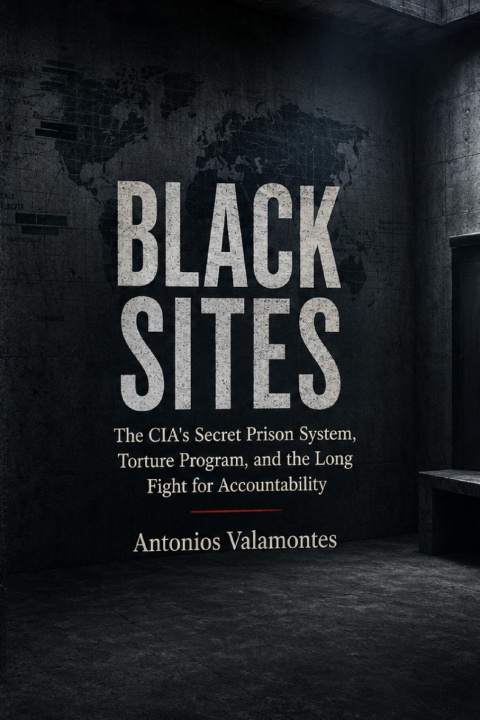
After September 11, 2001, the CIA built a secret detention system designed to operate beyond ordinary public scrutiny. Prisoners were captured, rendered across borders, held at clandestine facilities, and subjected to interrogation techniques that would become among the most controversial practices of the post-9/11 era.
BLACK SITES reconstructs that system from the documentary record.
Drawing on the U.S. Senate Intelligence Committee's investigation, declassified CIA files, Inspector General reports, FOIA releases, European Court of Human Rights judgments, Council of Europe investigations, International Committee of the Red Cross findings, and other primary sources, the book traces the development, operation, exposure, and eventual collapse of the CIA's Detention and Interrogation Program.
It examines the detention sites in Afghanistan, Thailand, Poland, Romania, Lithuania, and the wider rendition network that connected airports, foreign intelligence services, military facilities, contractors, and host governments. It follows individual detainee cases to test official claims about interrogation effectiveness, wrongful detention, internal dissent, medical involvement, destroyed evidence, and accountability.
The book also investigates the legal architecture that made the program possible: the Office of Legal Counsel memoranda, CIA reliance on classified legal guidance, congressional and executive oversight failures, the destruction of interrogation videotapes, later criminal reviews, and the enduring question of why so little individual accountability followed such an extensively documented program.
BLACK SITES does not treat every allegation as established fact. It distinguishes documented CIA detention facilities from rendition nodes, foreign-partner facilities, logistical sites, and locations that remain alleged or unconfirmed. That evidentiary discipline extends to the broader question of what makes a government facility truly "black": not secrecy alone, but a hidden function demonstrated by evidence.
This is a documented history of how a clandestine system was created, how it operated across national borders, how its own internal records exposed its failures, and how secrecy continued to shape accountability long after the prisons themselves began to disappear.