What happens when an official record ends, but public suspicion keeps moving?
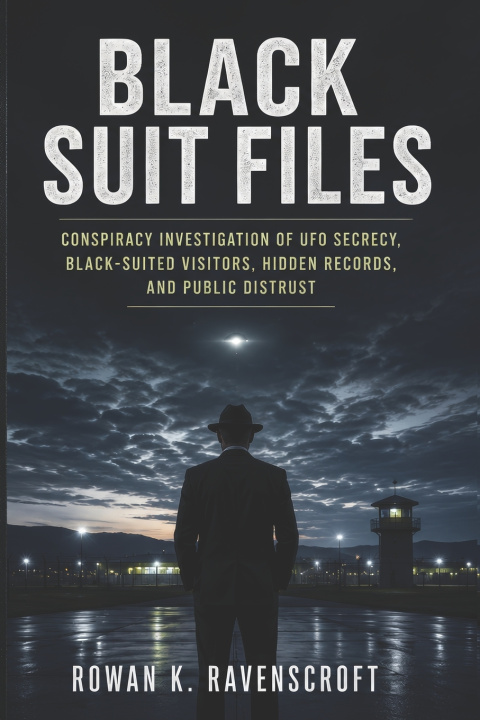
Black Suit Files is an evidence-aware investigation of the Men in Black legend, UFO and UAP history, government secrecy, hidden records, media amplification, and the distrust that grows when institutions control more information than they can publicly explain.
The trail begins in early Cold War saucer culture with Albert K. Bender, the International Flying Saucer Bureau, and the silence that helped give black-suited visitors their durable form. From there, the book follows the legend through official UFO investigations, Project Blue Book, unresolved reports, intelligence concerns, classified aircraft, public-education strategies, incomplete archives, and the widening space between what authorities documented and what citizens believed had been withheld.
Rather than treating every strange account as proof-or every official denial as closure-the investigation keeps claims beside their limits. Witness warnings, disappearing evidence, anonymous visitors, and alleged intimidation are examined as stories that may preserve fear, absorb later embellishment, or reflect genuine pressure without automatically establishing a coordinated secret program. The question is not simply whether the Men in Black were real. It is why the image became such a powerful way to represent authority without accountability.
The book also traces how newsletters, paperbacks, film, television, and the internet transformed a fringe UFO narrative into a public symbol. As the black suit moved from testimony into popular culture, repeated details began to shape memory, expectation, and later reports. Folklore, media incentives, and institutional ambiguity became part of the same feedback loop.
The investigation then enters the modern UAP era: congressional attention, whistleblower claims, oversight disputes, NASA, AARO, data quality, official-sounding program names, and the renewed demand for disclosure. Testimony is separated from documentation, administrative language from operational proof, and unresolved evidence from extraterrestrial conclusions.
Two Chronology Dockets compare the verified baseline with the spread and mutation of the narrative. A graded Evidence Docket identifies source types, what each record supports, what it does not prove, and where uncertainty remains. Together, these tools turn a familiar conspiracy story into a disciplined examination of records, rumor, secrecy, and belief.
Written in a restrained investigative style, Black Suit Files is for readers drawn to UFO nonfiction, UAP history, Project Blue Book, government files, conspiracy culture, unexplained aerial phenomena, and the psychology of public distrust. It offers no certainty the evidence cannot carry-only a careful path through what is documented, what is alleged, and what would be required to prove the difference.
Enter the file with curiosity, but keep the burden of proof intact.