Deep learning is powerful. But power without judgment can become confusion.
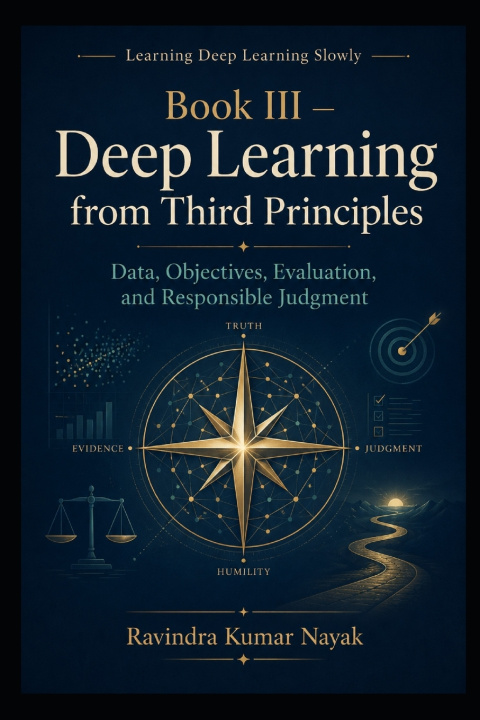
Book III - Deep Learning from Third Principles: Data, Objectives, Evaluation, and Responsible Judgment is a calm, practical, first-principles guide for non-technical readers who want to understand deep learning beyond formulas, tools, and impressive model scores.
This book does not rush you into coding. It does not assume you already understand data science, machine learning, mathematics, or artificial intelligence. Instead, it begins with the question every thoughtful builder, learner, manager, student, teacher, founder, or decision-maker must learn to ask:
Are we solving the right problem, with the right data, for the right purpose?
In Book I, the reader learned what it means for a system to learn. In Book II, the reader entered the inner mechanism: neurons, layers, weights, loss, gradients, and training loops. Now Book III moves into the judgment layer: the real-world space where deep learning projects succeed, fail, mislead, or responsibly serve people.
Here, the reader learns how to think before building.
You will learn why data is not the whole world, why labels carry human judgment, why accuracy is not always enough, why a high confidence score can still be wrong, why a model can improve on paper while failing in real use, and why sometimes the wisest deep learning decision is not to use deep learning at all.
Written in simple, layered language, this book helps non-technical readers understand:
What makes a problem suitable for deep learning
How to separate a real problem from a vague wish
Why data quality matters more than data size alone
How labels shape what a model learns
Why objectives quietly control model behavior
How evaluation should earn trust, not decorate a dashboard
Why accuracy, precision, recall, false positives, and false negatives matter
How data leakage, bias, drift, and overconfidence create hidden risk
When human review is necessary
When a simpler method may be safer, clearer, and more responsible
Book III is built for readers who want confidence without pretending. It explains deep learning judgment through everyday examples, dialogues, mind maps, reflective poetry, builder checklists, and practical thinking exercises. The goal is not to make the reader sound technical. The goal is to help the reader think clearly when powerful tools enter real decisions.
This book is especially useful for beginners, students, non-technical professionals, educators, founders, product thinkers, managers, creators, and curious readers who want to understand artificial intelligence responsibly before trusting or applying it.
The Value Edition at the end turns the whole book into a practical thinking workshop. It includes scratch-layer revision, brain training, math-fear removal, problem chunking, decision checklists, use-case labs, and responsible builder tools so the reader can carry the ideas into real conversations and projects.
Deep learning is not only about models.
It is about questions.
It is about evidence.
It is about human consequences.
It is about knowing when to build, when to pause, and when to refuse.
If you want a gentle but serious guide that teaches deep learning judgment from the ground up, this book gives you a slow, clear, and responsible path forward.