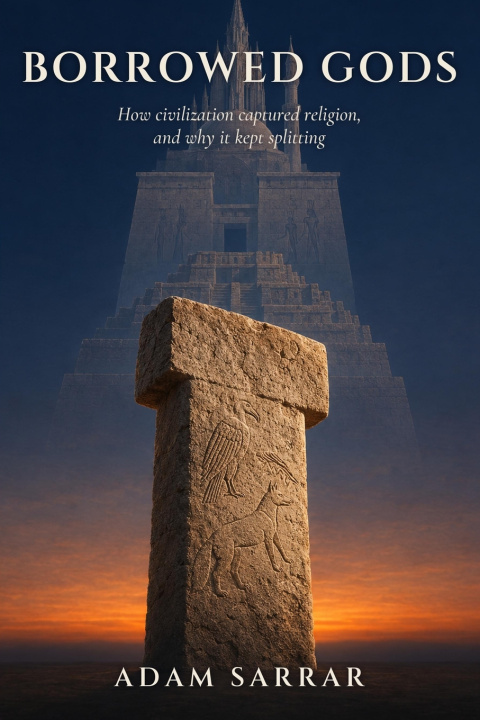
Religion is older than the city. The city borrowed it, gave it a watcher and kept the versions that worked.
Religion is thirty thousand years older than the first city, and for most of that time its gods watched no one. Then farming and war crowded people into cities full of strangers, and something had to see the grain clerk skimming the sack when no one else could. The answer, again and again, on four continents, was a watcher.
Adam Sarrar began this book convinced that religion was what held civilization together. He put that belief on trial against the largest database of human history ever built, against a famous paper that was retracted and then turned out right, against experiments in eight societies and two hundred American communes and against the historical record of Egypt, China, India, the Andes and the steppe. Some of it held. Some of it did not.
Along the way: an anthropologist's Christmas ox mocked as a bag of bones; a hilltop temple in Turkey that was never a temple; the Egyptian dead reciting the weights they never cheated; a Chinese Heaven that fires kings; karma whispered in secret at a king's court; an emperor who carved his remorse into rock; a mother and seven sons who died rather than eat pork; a friar selling salvation by the coin; and a Copenhagen receptionist deciding what to do with a stranger's wallet.
The result is a story about why every large society built something to watch its people, why that watcher kept splitting and what we owe ourselves as we take it down.