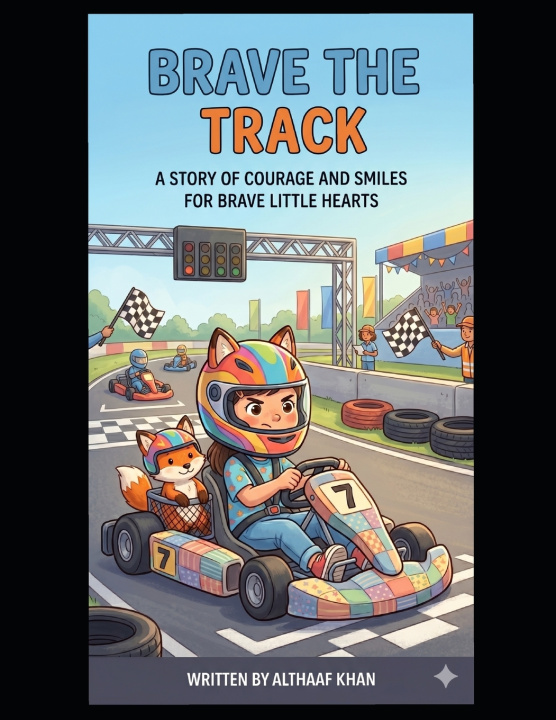
A quiet hospital room is just a starting grid in disguise.
For Leo, Room 4B is filled with boring white walls, beeping machines, and a lot of waiting. But when a mysterious, glowing lightning bolt button appears on his bed's control panel, everything changes. With a single click, his hospital bed transforms into an electric-blue hyper-car, and the quiet ward melts away into the high-speed, neon-lit world of the Horizon Circuit!
Brave the Track is a thrilling, imaginative adventure that takes young readers on a high-octane journey where courage is the ultimate fuel. As Leo navigates digital storms, treacherous loops, and the deafening Magnetic Pulse Tunnel, he discovers that the bravery it takes to win a race is the exact same bravery he needs in the real world.
Along the way, Leo builds an unstoppable racing team with Maya, a fearless co-driver navigating her own medical challenges, and Sam, who learns his heavy cast is actually a reinforced titanium chassis. Together, they prove that you are never just a patient-you are a champion.
Perfect for young readers facing medical challenges, Brave the Track turns the scary, unpredictable clinical environment into a world of empowerment, teamwork, and high-speed fun.
Benefits of the BookReframes Medical Trauma into Adventure: The story brilliantly translates intimidating hospital experiences into exciting racing challenges. An overwhelming MRI machine becomes the "Magnetic Pulse Tunnel," and the pinch of a needle becomes a bump on the track, helping children process their fears through an empowering metaphor.
Encourages Bravery and Emotional Resilience: By watching Leo, Maya, and Sam tackle high-speed obstacles, young readers learn to find their own inner strength. The book provides a practical coping mechanism: focusing on the "finish line" and trusting their "engine."
Promotes Pure Escapism: The vivid, neon-lit Horizon Circuit offers a much-needed mental escape from the stark, repetitive environment of a hospital ward, allowing a child's imagination to run free when their physical movement is limited.
Builds a Sense of Community: The inclusion of characters with different medical needs (a wheelchair, a heavy leg cast, an IV) validates a variety of pediatric experiences. It shows children that they are part of a larger, supportive "racing team" rather than being isolated in their rooms.
Provides a Communication Tool for Caregivers: The racing terminology offers parents, nurses, and doctors a playful, non-threatening vocabulary to use with pediatric patients (e.g., checking "chassis integrity" or warming up the "engine"), making clinical interactions smoother and less frightening.