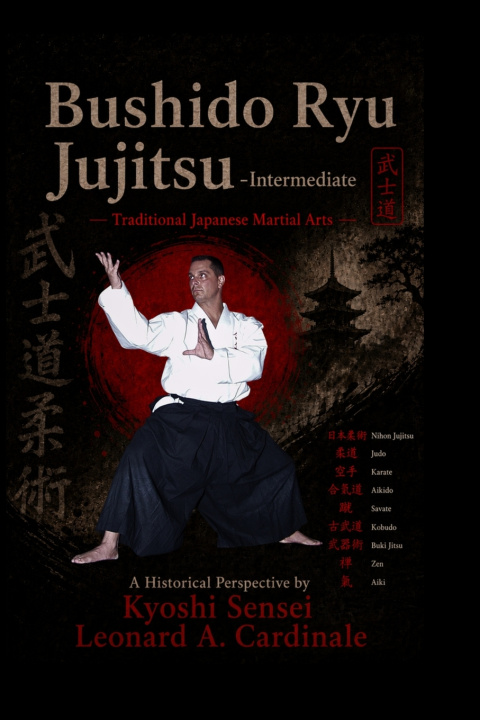
Bushido Ryu Jujitsu: Intermediate - Traditional Japanese Martial Arts A Historical Perspective Ny Kyoshi Sensei Leonard A. Cardinale
(REGULAR FONT) Within this 2nd Edition, Intermediate book, Kyoshi Sensei Leonard A. Cardinale, Creator of Black Dragon Martial Arts Federation, passes on a Historical and Philosophical Perspective on Bushido Ryu Jujitsu, a Traditional Japanese Martial Arts system that integrates a wide range of disciplines into one coherent and morally governed Martial Way. It follows the student's journey through the intermediate and early advanced ranks, showing how progress in the Art is not measured only by physical technique, but also by the growth of discipline, judgment, restraint, and character. The book explains that Bushido Ryu Jujitsu is not a casual collection of techniques, but a structured tradition in which rank, ethics, movement, responsibility, and historical continuity all work together. In that sense, the manuscript is both a record of martial knowledge and a reflection on the deeper meaning of long-term training.
A central purpose of the book is to show how the many disciplines within Bushido Ryu Jujitsu contribute to one complete traditional martial system. These include Traditional Japanese Jujitsu, Judo, Aikido, Karate, Savate, Iaido, Kenjutsu, and Bukijutsu, along with internal development, Ki training, teaching progression, and the moral responsibilities of rank. Each Art is treated as a true discipline in its own right, yet the book emphasizes that they are also integrated through component principles such as timing, distance, blending, posture, control, awareness, and lawful use of force. In this way, the manuscript presents Bushido Ryu Jujitsu as a Martial Style in which armed and unarmed practice, striking and throwing, movement and stillness, and technical power and ethical restraint all belong to the same larger philosophy of training.
The manuscript explores not only throws, strikes, evasions, restraints, and weapons studies, but also concepts such as Movement and Non-Movement, Action and Non-Action, Mushin, Zanshin, KI, Composure, Leadership, Teaching, Legacy, and the preservation of Martial Knowledge through History. As a result, the book is as much about the inward life of the practitioner as it is about Martial Form.