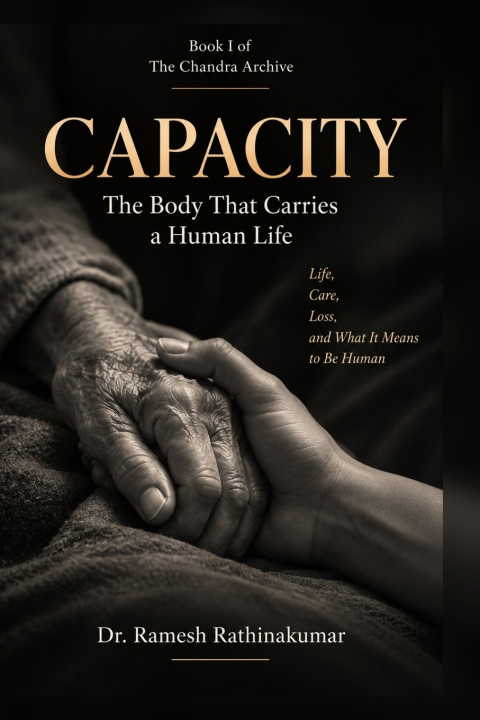
CAPACITY
The Body That Carries a Human Life
We spend much of our lives asking what we want to do with our bodies. Rarely do we ask what happens when the body can no longer do what life requires.
Walking to the bathroom. Lifting a spoon. Swallowing water. Turning in bed. Speaking a sentence. Taking the next breath.
These actions seem almost too ordinary to notice-until they become difficult.
Capacity began during the final months of Chandra's life, when her son, scientist and author Dr. Ramesh Rathinakumar, became one of her caregivers. As serious illness progressively changed what her body allowed her to do, he witnessed something that years of scientific training had never made quite so visible:
Much of what we call independence, dignity, and participation in life rests upon physical capacities we rarely appreciate while we still possess them.
What began as a son's experience of caring for his mother became a larger investigation into the human body.
Why does inactivity sometimes accelerate physical decline? Why does an ordinary task become exhausting when physiological reserve diminishes? What happens when breathing itself becomes work? How do strength, balance, mobility, nutrition, sleep, pain, movement, and recovery interact? And perhaps most importantly:
What can understanding the loss of capacity teach us about caring for the body before it asks for help?
Blending lived experience with biomedical science, movement knowledge, and careful reflection, Capacity explores the body not as a collection of organs and muscles, but as an interconnected system that gives us the ability to participate in life.
This is not a book promising that exercise can defeat aging or prevent every disease. Illness can arrive despite discipline. Aging cannot be negotiated away. Biology offers no guarantees.
But capacity matters.
For the healthy reader, this book offers a different reason to care for the body-not simply to look fit, but to preserve strength, mobility, balance, breath, adaptability, and physiological reserve for the years ahead.
For older adults and those experiencing changing physical abilities, it offers a way to understand why seemingly small losses can have profound effects on independence.
For caregivers, it enters the realities that medicine cannot fully capture: when to help, when to encourage independence, how ordinary acts of care acquire extraordinary meaning, and what dignity can look like when another person must increasingly depend upon us.
For movement practitioners, teachers, and anyone interested in longevity, it asks a more useful question than How fit am I?
How much of life can my body still allow me to participate in?
Capacity is Book I of The Chandra Archive, a three-book inquiry that moves from body, to mind, to what remains. It begins with the most tangible foundation of human existence-the body-and with one mother's final journey that made its extraordinary value impossible to overlook.
Because eventually, capacity changes for all of us.
The question is whether we will understand its value only after it begins to disappear.
Read Capacity before the body asks for help.