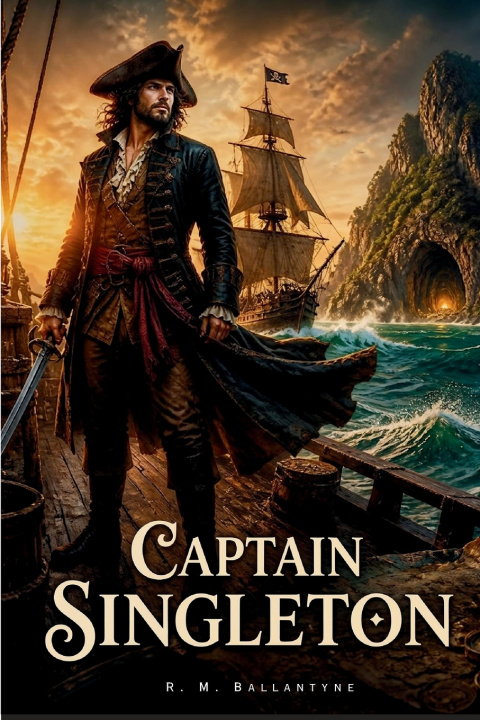
Adventure, danger, piracy, and the lure of distant horizons come together in Daniel Defoe's Captain Singleton, a remarkable tale of survival and fortune from one of the great pioneers of the English novel.
Born into uncertain circumstances and carried into a life shaped by forces beyond his control, Bob Singleton grows up far from the security of an ordinary home. From an early age, he learns that survival depends upon courage, adaptability, and an ability to recognize opportunity wherever it appears. His restless path soon leads him across oceans and continents, through unfamiliar lands, dangerous encounters, and a world in which fortune can change without warning.
Singleton's adventures take him far beyond the familiar shores of England. He experiences extraordinary journeys across Africa, faces hardship in remote and unforgiving landscapes, and eventually turns toward the dangerous world of the sea. There, piracy offers the promise of wealth and independence-but also exposes him to violence, uncertainty, and the constant possibility of disaster. Ships, storms, treasure, trade, and encounters with people from distant regions create a sweeping narrative filled with the excitement and unpredictability of eighteenth-century travel.
Yet Captain Singleton is more than a straightforward pirate adventure. Daniel Defoe brings the same fascination with practical detail, survival, commerce, and human resourcefulness that made Robinson Crusoe one of the most influential adventure novels ever written. Singleton carefully observes the world around him, weighing risks and opportunities with the calculating mind of a man determined to control his own destiny.
Among the most memorable elements of the novel is Singleton's relationship with William Walters, a Quaker whose intelligence, loyalty, and moral perspective provide a striking contrast to the rough world of piracy. Their companionship gives the story an additional dimension, raising questions about friendship, conscience, wealth, and whether a person shaped by a life of lawlessness can imagine another path.
First published in 1720, Captain Singleton reflects an era fascinated by exploration, maritime trade, distant territories, and tales of extraordinary journeys. Defoe combines realistic detail with dramatic adventure, creating a fictional memoir that often feels like the testimony of a real traveler recounting an astonishing life.
Readers who enjoy classic sea stories, pirate fiction, historical adventures, survival narratives, and tales of exploration will discover a compelling journey through a world of danger and possibility. From hazardous expeditions across unknown landscapes to the unpredictable life of a pirate at sea, Singleton's story moves with the restless energy of a man who refuses to remain in one place for long.
Bold, atmospheric, and filled with the spirit of exploration, Captain Singleton remains a fascinating classic of early adventure fiction-a story of a wanderer navigating a vast world where courage, cunning, friendship, and fortune can determine the course of a life.