Your Cath Lab Needs More Than Another Physician Text
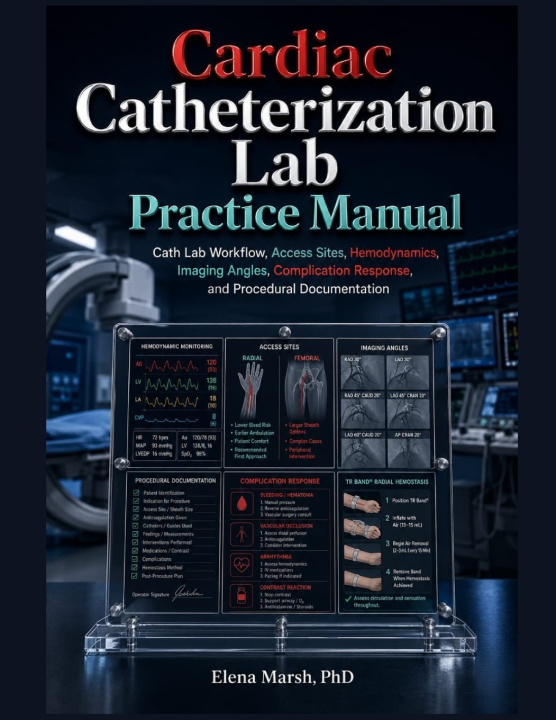
Cardiac catheterization lab practice manual for cath lab teams who need clear steps, role ownership, and case-ready documentation before the next patient enters the room.
When the Room Gets Fast, Informal Training Shows Its Gaps
Most cath lab staff learn by watching, asking, and hoping the same person is on shift when the next hard case appears. That can work for routine days. It breaks down when access changes, pressures look wrong, the C-arm angle matters, or a complication starts before anyone has named it.
This cath lab manual is built for those moments. It gives nurses, RCIS technologists, monitor-recorders, scrub staff, charge leads, and service line directors a shared language for what happens next.
A Staff-Facing System Built Around the Next Step
This is not a cardiology theory book dressed as a room guide. Each major workflow is written as a numbered SOP with inputs, outputs, time targets, and responsible parties. You can see who owns the step, what must be true before it starts, and what must be documented when it ends.
That structure turns scattered training into a repeatable system.
What You Can Put to Work Across the Service Line
Inside you get:
- Cath lab operations, case flow, room turnover, and team roles
- Pre-procedure assessment, medication review, time-out, and risk checks
- Radial, femoral, brachial, and distal transradial access workflows
- Hemodynamic setup, pressure tracing recognition, and output examples
- Imaging angles, C-arm positioning, radiation safety, and run planning
- Coronary angiography, left heart cath, and scrub setup sequences
- TAVR, MitraClip, Impella, ECMO, and structural heart workflow
- Tamponade, no-reflow, air embolism, VF, and contrast reaction response
- Procedure reports, nursing records, quality metrics, and audit checks
Built for Teams That Must Prove Their Work
A completed case is not finished until the record can defend what happened. This cardiac catheterization lab practice manual includes filled-in documentation examples, quality metric workflows, case review steps, and accreditation-ready file logic.
Use it to train a new staff member, tighten a case review, prepare a service line binder, or correct documentation habits before they become findings.
For New Staff, Busy Labs, and Programs Under Review
New to the cath lab? Start with the role-labeled SOPs and visual flow figures. Already experienced? Use the hemodynamic, imaging, structural heart, and emergency chapters to standardize the parts that still vary by room, operator, or shift.
No time to read cover to cover? Open to the procedure or problem in front of you. The manual is organized for point-of-care use.
Open to One Procedure and Get a Usable Answer
You can look up what must be checked before a patient enters the room, what to document during a pressure run, how to structure a cath report, which findings move beyond staff action, and what role each team member owns during an emergency.
That is the value of a true cath lab manual: less guessing, fewer handoff gaps, and a clearer record.
Bring Order to the Lab Before the Next Case Starts
Add Cardiac Catheterization Lab Practice Manual to your shelf and give your team a practical reference for workflow, access, imaging, hemodynamics, emergencies, documentation, and service line readiness. Use it to make the next case easier to set up, safer to run, and easier to close. Keep it near the room, the binder, and the people who own the work. Use it before orientation, after a hard case, during a quality review, or when a new workflow needs one written standard the whole team can follow without guessing who owns the next step. Keep one copy at the lab desk.