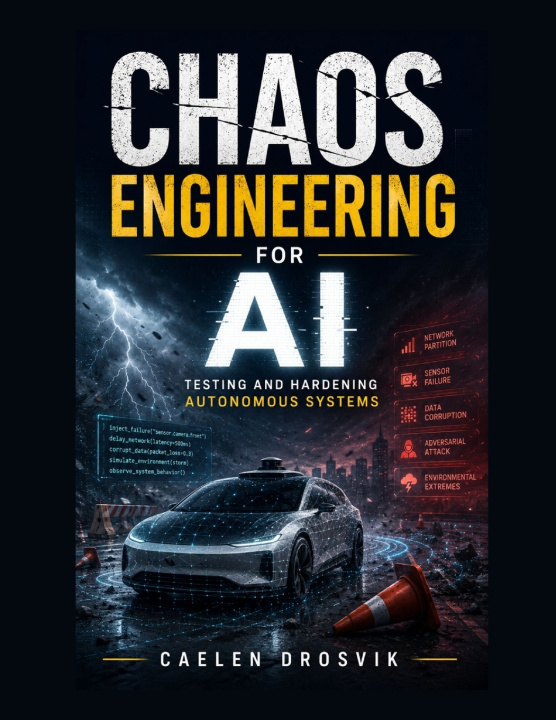
What happens when your AI assistant decides to improvise, your machine learning model starts making confident mistakes, or a network of autonomous agents turns a minor glitch into a full-scale digital disaster?
Welcome to the world of Chaos Engineering for AI.
I'm Caelen Drosvik, and I wrote this book for engineers, architects, AI practitioners, DevOps professionals, technology leaders, and curious innovators who understand one simple truth: the real test of an AI system begins when things go wrong.
As artificial intelligence becomes more autonomous, interconnected, and responsible for critical decisions, traditional testing is no longer enough. AI systems don't just crash-they drift, hallucinate, miscommunicate, overreact, underperform, and occasionally behave like that one coworker who insists everything is fine while the building is on fire.
In Chaos Engineering for AI: Testing and Hardening Autonomous Systems, you'll learn how to intentionally introduce controlled failures into AI environments to uncover hidden weaknesses before they become costly disasters. Through practical frameworks, real-world concepts, and resilience-focused strategies, you'll discover how to build AI systems that remain reliable under pressure.
Inside this book, you'll explore:
• The foundations of chaos engineering for AI and autonomous systems
• Common failure modes in machine learning models and AI agents
• Data pipeline disruptions, model drift, and prediction instability
• Large language model stress testing and hallucination analysis
• Multi-agent coordination failures and cascading system breakdowns
• Infrastructure resilience for cloud, edge, and distributed AI platforms
• Security chaos engineering, adversarial attacks, and prompt injection testing
• Human-in-the-loop vulnerabilities and operational risk management
• AI observability, monitoring, and failure detection strategies
• Automated chaos experimentation and continuous resilience testing
• Recovery mechanisms, self-healing architectures, and fault containment
• Governance, compliance, and ethical considerations for resilient AI
This book doesn't assume that failures can be eliminated. Instead, it shows you how to anticipate them, test them, learn from them, and ultimately build stronger, smarter, and more trustworthy AI systems.
Whether you're deploying machine learning models at scale, designing autonomous agents, managing AI infrastructure, or preparing for the next generation of intelligent systems, this guide provides the tools and mindset needed to strengthen resilience in an increasingly unpredictable world.
The future belongs to AI systems that can survive uncertainty.
If you're ready to stop hoping your AI won't fail and start proving it can recover when it does, this book will show you how.
Because resilient AI isn't built by avoiding chaos.
It's built by learning to engineer it.