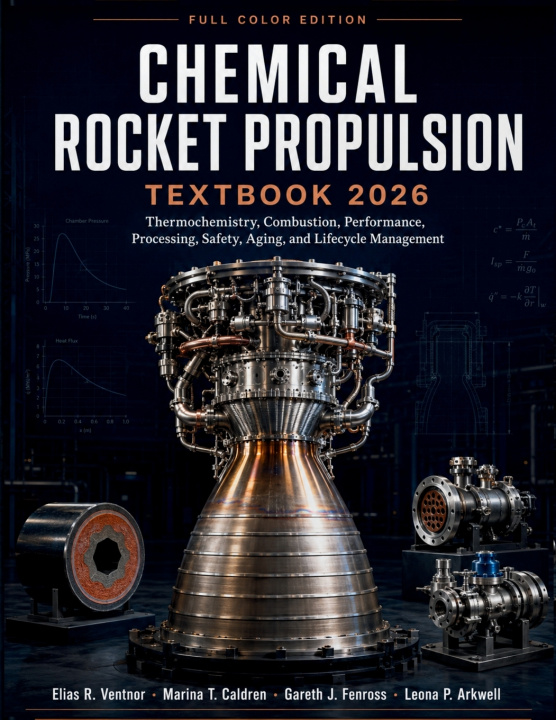
Rocket propulsion is not only a performance problem. It is a complete engineering lifecycle-from propellant selection and thermochemical analysis to manufacturing, testing, qualification, service life, and responsible disposal.
Chemical Rocket Propulsion Textbook 2026 brings these traditionally fragmented subjects into one rigorous, connected reference. Instead of treating thermodynamics, combustion, engine architecture, energetic materials, reliability, and safety as isolated topics, the book shows how every decision affects thrust, mass, cooling, manufacturability, operability, cost, risk, and mission success.
Across 30 chapters, the text develops the field from first principles and carries the reader into real engineering practice. You will examine chemical equilibrium, ideal and nonideal nozzle performance, scaling and uncertainty, ignition and instability, liquid-engine feed cycles, injectors, atomization, regenerative cooling, reusable-engine health, solid-grain internal ballistics, processing defects, hybrid regression, lower-toxicity propellants, energetic metals, additive manufacturing, qualification, surveillance, failure investigation, and future propulsion research.
Inside this comprehensive engineering reference:
Thermodynamic and chemical foundations explained with physical interpretation
- Liquid, solid, hybrid, monopropellant, and emerging propulsion systems
- Nozzle flow, combustion efficiency, heat transfer, materials, and operability
- Propellant processing, quality control, nondestructive evaluation, and defect prevention
- Hazard analysis, test planning, instrumentation, model validation, and configuration control
- Aging, storage, transport, environmental management, surveillance, and service-life decisions
- Worked engineering examples, integrated case studies, review problems, and selected solutions
- Thirty major visual plates, comparison tables, equations, checklists, property references, and a glossary
The book is written for senior undergraduate and graduate students, early-career propulsion engineers, aerospace materials and process specialists, test and reliability personnel, safety professionals, instructors, and experienced practitioners who need a structured cross-disciplinary desk reference.
Equations are presented with their assumptions, limits, units, uncertainty, and engineering meaning. Hazardous subjects are handled through legitimate educational principles, controlled-facility practice, risk management, and lifecycle governance-not unauthorized operational recipes.
Move beyond isolated formulas and build a systems-level understanding of how chemical propulsion is selected, analyzed, produced, verified, operated, sustained, and retired.