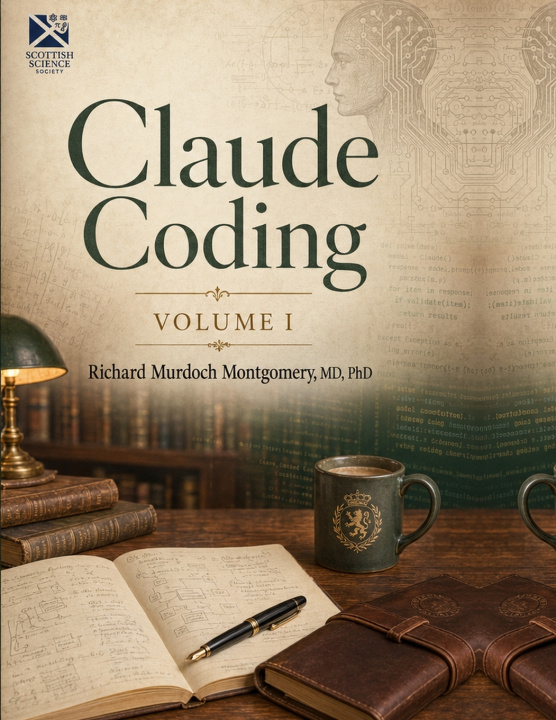
Könyv Claude Coding Volume 1 of 2 Richard Murdoch Montgomery

Claude Coding Volume 1 of 2

A Comprehensive Treatise on Agentic Software Development Vol 1; The Foundations, and the First Human Factors

Nyelv: Angol
Kötés: Puha kötésű
Elérhetőség: Várható készletfeltöltés
Küldés 10. 07. 2026
43 881 Ft
This is a strong, publishable Book for a niche but growing audience, with notable strengths in depth...

Információk a könyvről

Nyelv
Angol
Kötés
Könyv - Puha kötésű
Kiadva
2026
oldal
586
EAN
9798185619810
Enbook ID
53203028
Súly
1865
Méretek
216 x 280 x 39

Teljes leírás

This is a strong, publishable Book for a niche but growing audience, with notable strengths in depth and structure, tempered by stylistic and market risks. Volume I (foundations through human factors, Chapters 1-53) stands well on its own as promised, while setting up the series. It feels like a deliberate attempt at a "classic" treatise in the vein of older engineering texts (e.g., Brooks' Mythical Man-Month or Knuth's works), updated for the agentic AI era.

Strengths
  • Timely and Substantive Contribution: Agentic coding (tools like Claude Code that go beyond autocomplete to read/edit/run code in a loop) is a real 2025-2026 shift. Anthropic's own reports and developer discussions confirm the move toward supervision, verification, context management, multi-agent orchestration, and calibrated trust-exactly the book's core thesis. The emphasis on verification as the new center of gravity, reversibility, and human judgment over fluency is insightful and practical. It avoids hype in favor of disciplined realism, which is refreshing and valuable.
  • Rigorous Structure: Consistent chapter format (prose argument + quantitative thread + worked example + exercises with solutions) is excellent for a practitioner book. The delegation model (geometric distribution for attempts, speed-up S(p), overheads) in Chapter 1 is a highlight-simple, derivable math that grounds the philosophy. TOC shows comprehensive coverage: from basics to advanced engineering, languages, security, multi-agent, and psychology.
  • Depth and Original Framing: It treats the tool as a "junior colleague" requiring supervision rather than magic. Sections on mental models, .claude config, skills/workflows, permission modes, and reviewing AI code fill a gap between shallow "prompting guides" and raw docs. The literary/historical tone (genealogy of tools, control loops as contractions) adds gravitas.
  • Production Quality: Clean typesetting (EB Garamond), professional front matter, disclaimers, and ISSN. It positions itself as independent scholarship, which is smart given trademark sensitivities.