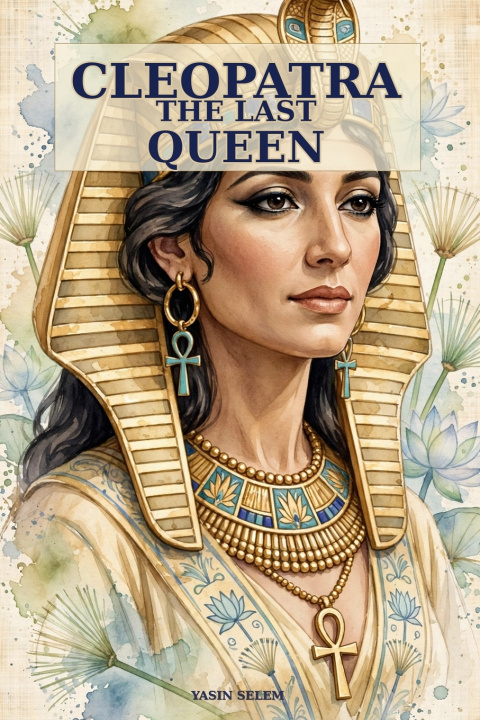
CLEOPATRA: THE LAST QUEEN
Cleopatra. Julius Caesar. Rome. Egypt.
Their names are inseparable from one of the most dramatic turning points in the ancient Mediterranean world.
Cleopatra VII was far more than the legendary queen remembered through later stories and romanticized images. She was the last great ruler of Ptolemaic Egypt, a highly educated monarch who inherited a kingdom facing political instability, dynastic conflict, economic pressures, and the growing power of Rome.
When Julius Caesar arrived in Alexandria in 48 BCE, Cleopatra's struggle for the Egyptian throne became connected to the fate of the Roman Republic itself.
Their alliance changed the balance of power.
Their relationship produced Caesarion, a child whose existence would later become politically explosive.
And their connection placed Egypt at the center of the violent struggle that followed Caesar's assassination.
CLEOPATRA: THE LAST QUEEN follows Cleopatra's life and reign through the surviving historical evidence, from the foundations of the Ptolemaic dynasty to the final days of the Egyptian monarchy.
The book examines Cleopatra's family, education, accession to the throne, exile, return to power, relationship with Julius Caesar, and later alliance with Mark Antony. It also explores the growing confrontation between Cleopatra and Octavian, the Battle of Actium, the collapse of Antony and Cleopatra's power, and the transformation of Egypt into a Roman possession.
Rather than relying on legends alone, this book examines the evidence left behind by the ancient world.
Papyri.
Inscriptions.
Coins.
Royal decrees.
Temple reliefs.
Ancient manuscripts and documentary records.
Among the surviving evidence are documents connected with Cleopatra's administration, inscriptions honoring the queen and Caesarion, and archaeological remains that reveal how the Ptolemaic monarchy presented itself to both the Greek-speaking world and the ancient Egyptian religious tradition.
The book also distinguishes between what can reasonably be established from ancient evidence and what remains uncertain or comes from later literary tradition.
Was Cleopatra truly the woman described by Roman writers?
What did Julius Caesar see in the Egyptian queen?
Was their relationship primarily political, personal, or inseparably both?
Why did Rome become so deeply involved in the affairs of Egypt?
And how did the alliance between Cleopatra and Mark Antony ultimately bring the Ptolemaic kingdom to its end?
From Alexandria to Rome, from Caesar to Antony, and from Actium to the final days of Cleopatra, this book reconstructs the history of a queen whose death marked the end of an era.
Cleopatra was the last queen of Ptolemaic Egypt.
But her story was also the story of a kingdom caught between two worlds-
Egypt and Rome.
And at the center of that struggle stood Cleopatra and Julius Caesar.