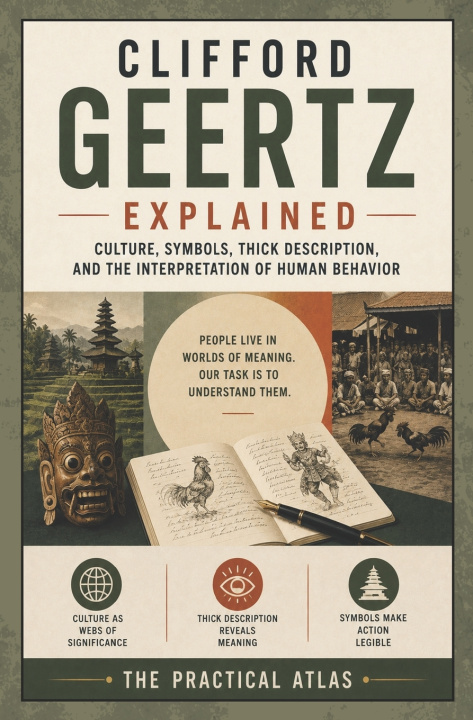
Clifford Geertz Explained: Culture, Symbols, Thick Description, and the Interpretation of Human Behavior introduces one of anthropology's most widely read interpreters of culture with a focus on the ideas and case studies that made his work matter. Geertz argued that human behavior cannot be understood by listing rules, instincts, or social functions alone. People live inside shared systems of meaning, and those meanings shape how they joke, pray, celebrate, obey, compete, and display status. This book explains that argument in plain language, showing why Geertz treats culture as something public, symbolic, and interpretive rather than hidden inside the mind or reducible to biology or statistics.
The book stays close to Geertz's actual concerns. It explains his account of culture as webs of significance, his contrast with more mechanical models of social explanation, and his view that social action must be read in context. A wink is not just an eye movement. A ritual is not just repeated behavior. A public event is not just spectacle. Geertz's point is that meaning depends on shared understandings, local conventions, and the social settings in which acts become legible. The discussion makes clear what he means by symbols, why religion can be studied as a cultural system, and how common sense itself rests on learned assumptions about what counts as obvious, reasonable, or real.
The book also gives direct attention to Geertz's most important examples and interpretations. It offers a practical account of thick description and shows how careful observation can distinguish a gesture from a parody, a ceremony from a performance, or a contest from a statement about rank and honor. It examines ritual and symbolism, Geertz's analysis of kingship and the theater state, and his essays on art and local knowledge. A full discussion of the Balinese cockfight shows how Geertz moves from a concrete scene to larger claims about masculinity, status rivalry, collective emotion, and social order.
Written for students, general readers, and anyone who wants a usable introduction to cultural interpretation, this guide makes Geertz clearer without flattening his ideas. It is especially useful for readers interested in anthropology, sociology, religion, cultural studies, and the interpretation of everyday life. If you want a focused explanation of thick description, symbolic analysis, ritual, public meaning, and Geertz's most famous arguments, this book provides a practical starting point.
FROM THE HALF HOUR HELP SERIES OF BOOKS
The Half Hour Help Series is a collection of concise, practical guides designed to teach the basics of a subject or provide quick solutions to everyday problems. Each book is crafted to be read in about 30-60 minutes, making it ideal for busy readers who want to learn something new or solve a specific issue without wading through lengthy manuals or complex jargon.
Whether you're looking to understand a new concept, develop a skill, or tackle a challenge, these guides break things down into simple, actionable steps.
Focused on clarity and efficiency, the Half Hour Help Series covers a wide range of topics-from personal development and productivity to science and technology, wellness, culture, and beyond.
Every title is built around the idea that a little help can go a long way, and with just half an hour, readers can gain valuable insights and confidence to move forward.
It's smart support when you need it, without the fluff.