Turn clinical knowledge into safer decisions, smarter workflows, and more effective care.
Healthcare professionals work in environments filled with complex evidence, expanding data, competing priorities, and limited time. Clinical decision support systems can help transform this information into timely, relevant, and actionable guidance-but only when they are designed, implemented, and evaluated correctly.
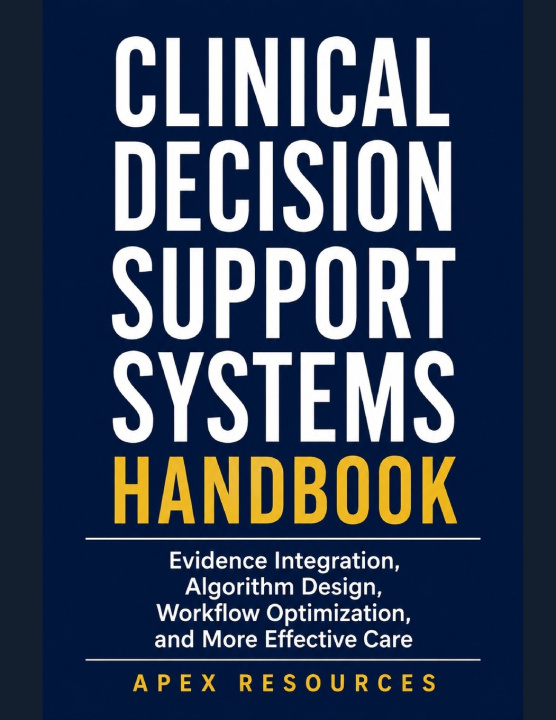
**Clinical Decision Support Systems Handbook** provides a practical and structured guide to the principles, technologies, and management strategies behind effective clinical decision support.
Created for clinicians, healthcare informaticians, administrators, analysts, developers, quality professionals, researchers, students, and organizational leaders, this handbook explains how clinical knowledge can be converted into tools that support better decisions at the point of care.
Readers will explore:
• Foundations of clinical decision support
• Evidence acquisition and knowledge management
• Clinical guidelines and decision rules
• Algorithm and logic design
• Rule-based decision-support systems
• Predictive models and risk scoring
• Artificial intelligence and machine learning
• Electronic health record integration
• Alerts, reminders, order sets, and documentation tools
• Diagnostic and therapeutic support
• Medication-safety systems
• Population-health decision support
• Clinical workflow analysis
• Human factors and usability
• Alert fatigue and cognitive burden
• Data quality and interoperability
• Implementation planning
• Validation and clinical testing
• Performance monitoring
• Bias, fairness, and transparency
• Patient safety and risk management
• Privacy, security, and governance
• Regulatory and ethical considerations
• Quality improvement and outcome evaluation
Rather than treating technology as a separate layer of healthcare, this handbook demonstrates how clinical decision support must fit naturally into the work of clinicians, nurses, pharmacists, administrators, and care teams.
It explains how to identify a clinical need, select trustworthy evidence, structure decision logic, integrate a tool into workflow, monitor performance, and determine whether the system is producing meaningful improvements.
Readers will learn how to:
• Translate clinical evidence into decision-support logic
• Design useful alerts without overwhelming clinicians
• Develop algorithms with clear inputs and outputs
• Integrate support tools into electronic workflows
• Recognize bias, unintended consequences, and safety risks
• Evaluate sensitivity, specificity, accuracy, and clinical value
• Improve adoption through usability and stakeholder involvement
• Monitor system performance after implementation
• Support responsible governance and continuous improvement
This handbook is ideal for:
• Physicians and advanced-practice clinicians
• Nurses and pharmacists
• Clinical informaticians
• Healthcare administrators
• Health-information professionals
• Data analysts and data scientists
• Software developers
• Quality and patient-safety leaders
• Digital-health professionals
• Medical and informatics students
• Researchers and implementation teams
Whether you are designing a new clinical tool, evaluating an existing system, leading a digital-health project, or studying healthcare informatics, this book offers a dependable framework for turning evidence and data into practical clinical support.
**Build decision-support systems that clinicians can trust, workflows can sustain, and patients can benefit from.