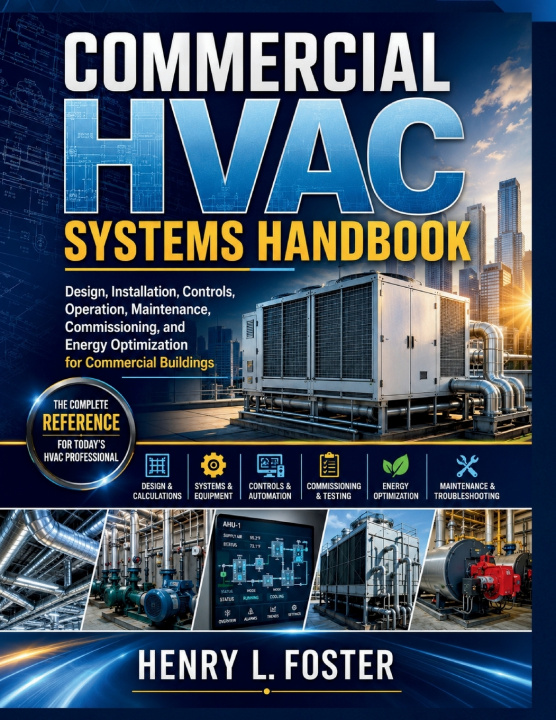
Most HVAC resources teach topics in isolation. A load calculation guide explains how to size equipment. A controls manual explains sequences. A maintenance checklist explains what to inspect. None of them explain how an early design decision quietly shapes what happens during installation eight months later, or why a control sequence that looks correct on paper can still fail during commissioning. That gap between individually correct information and a genuinely connected understanding of the system is where technicians, students, and junior engineers get stuck.
Commercial HVAC Systems Handbook was built to close that gap directly. Across seventeen chapters, it develops commercial HVAC systems the way they actually come together on a real project: starting with the thermodynamics and load calculations that determine what a building needs, moving through system selection and equipment design, then into the controls, installation coordination, and commissioning process that determine whether a correctly designed system actually performs as intended, and finishing with the preventive maintenance and energy optimization work that determines whether it keeps performing years later.
Every chapter teaches the underlying engineering principle first, then walks through real, worked calculations grounded in ASHRAE, SMACNA, and IMC standards, so the reader understands not just the correct number but why that number is correct.
Inside, you will find:
- A complete, connected path from building heat load calculations through equipment selection, installation, and commissioning
- Full development of building automation control sequences, including how they are actually verified against written design intent
- Real, worked calculations for load, equipment sizing, hydronics, and combustion, not simplified rules of thumb
- Field-based scenarios illustrating how real HVAC problems develop and how they are traced back to root causes
- A dedicated framework for measuring and verifying genuine energy savings after a retrofit or upgrade
This handbook covers building heat load calculations, HVAC system architecture, air handling units and ductwork, hydronic systems, chillers, boilers, cooling towers, terminal equipment, building automation and controls, commissioning, field installation coordination, preventive maintenance and troubleshooting, and energy optimization.
It is written for HVAC technicians and apprentices building their foundational understanding, technical and vocational college students preparing for the field, maintenance and facilities professionals responsible for keeping systems running, and junior mechanical engineers who need the connective tissue between design theory and real building performance.
Begin building a genuinely connected understanding of commercial HVAC systems with a handbook designed around how these systems actually work together, not around isolated topics. Add this practical resource to your library and start exploring the principles, methods, and applications covered inside.