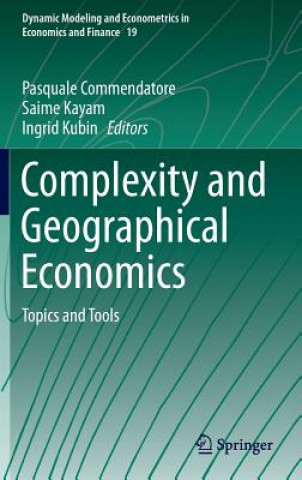
The uneven geographical distribution of economic activities is a huge challenge worldwide and also for the European Union. In Krugman s New Economic Geography economic systems have a simple spatial structure. This book shows that more sophisticated models should visualise the EU as an evolving trade network with a specific topology and different aggregation levels. At the highest level, economic geography models give a bird eye s view of spatial dynamics. At a medium level, institutions shape the economy and the structure of (financial and labour) markets. At the lowest level, individual decisions interact with the economic, social and institutional environment; the focus is on firms decision on location and innovation. Such multilevel models exhibit complex dynamic patterns path dependence, cumulative causation, hysteresis on a network structure; and specific analytic tools are necessary for studying strategic interaction, heterogeneity and nonlinearities.