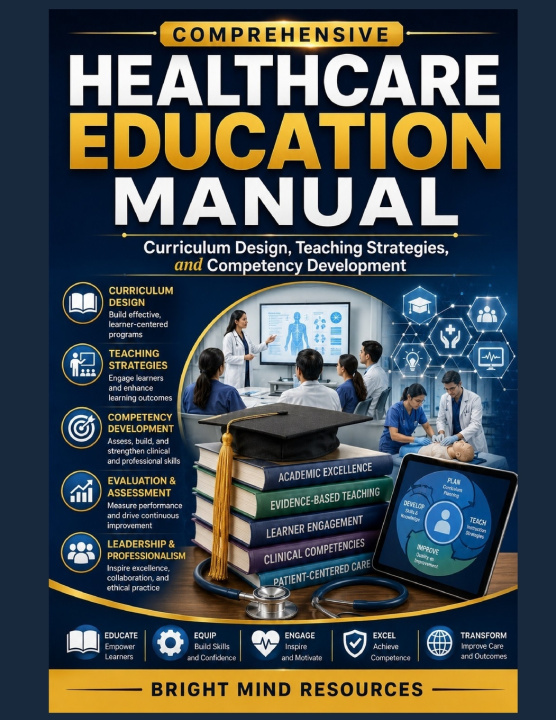
COMPREHENSIVE HEALTHCARE EDUCATION MANUAL
Healthcare education is more than delivering information.
Effective healthcare education requires thoughtful curriculum design, appropriate teaching strategies, meaningful assessment, competency development, learner engagement, clinical application, and continuous improvement.
**Comprehensive Healthcare Education Manual** provides a structured reference for understanding and applying the major principles involved in designing, delivering, evaluating, and improving healthcare education programs.
Whether the learning environment is a classroom, clinical setting, simulation center, skills laboratory, online platform, or professional-development program, effective education depends on connecting learning objectives with appropriate instructional methods and meaningful assessment.
This manual explores:
• Healthcare education foundations
• Curriculum development
• Learning objectives
• Competency-based education
• Instructional design
• Adult learning principles
• Teaching strategies
• Clinical teaching
• Simulation-based education
• Skills development
• Learner engagement
• Classroom management
• Clinical supervision
• Preceptorship
• Mentoring and coaching
• Assessment and evaluation
• Competency assessment
• Written examinations
• Practical skills assessment
• Performance-based evaluation
• Feedback and remediation
• Educational technology
• Online and blended learning
• Faculty development
• Program evaluation
• Educational quality improvement
• Learning outcomes
• Professional development
The book emphasizes a practical connection between **what learners need to know, how they learn, how educators teach, and how competence is demonstrated.**
Curriculum design is examined as a structured process involving needs assessment, learning outcomes, content selection, instructional planning, sequencing, implementation, assessment, and evaluation.
Teaching strategies are considered in relation to the learner, learning environment, educational objectives, complexity of the subject, available resources, and expected professional performance.
Competency development receives particular attention because healthcare professionals must do more than recall information. They must be able to apply knowledge, perform skills safely, communicate effectively, exercise professional judgment, and respond appropriately to real-world situations.
The manual also explores assessment as an essential component of education.
Effective assessment can identify learning gaps, document achievement, guide feedback, support remediation, and help educators determine whether learners are prepared to perform expected responsibilities.
Readers will also find practical approaches to learner engagement, clinical instruction, simulation, feedback, mentoring, coaching, educational technology, faculty development, and program evaluation.
Designed for healthcare educators, clinical instructors, academic leaders, trainers, preceptors, students, healthcare managers, and professional-development specialists, this manual provides a broad framework for building stronger healthcare learning environments.
Whether used for professional reference, academic study, educator development, curriculum planning, or institutional training, **Comprehensive Healthcare Education Manual** provides a practical foundation for connecting education with competency, performance, and better professional practice.
**DESIGN BETTER LEARNING. DEVELOP STRONGER COMPETENCE. EDUCATE FOR BETTER CARE.**