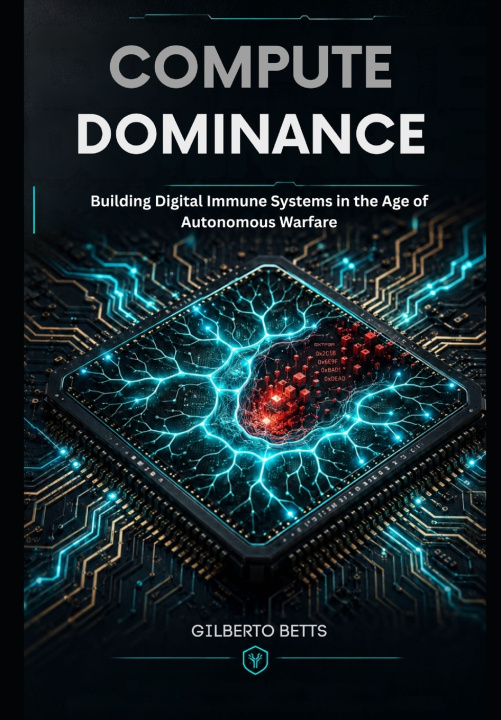
Compute Dominance: Building Digital Immune Systems in the Age of Autonomous Warfare
For decades, organizations have relied on firewalls, perimeter defenses, and reactive security models to protect their most critical systems. Those approaches were designed for an era when threats moved at human speed. That era is over. Today, autonomous algorithms can discover vulnerabilities, generate exploits, infiltrate networks, and adapt to defenses in milliseconds. In a world where artificial intelligence drives both attack and defense, static security architectures are becoming obsolete.
Compute Dominance introduces a revolutionary framework for surviving and thriving in this new reality. Drawing inspiration from biology, military strategy, distributed systems, artificial intelligence, and next-generation computing, this book presents the blueprint for building Digital Immune Systems (DIS) autonomous, self-healing infrastructures capable of detecting, isolating, and neutralizing threats before human operators even become aware of them.
Inside, you will discover how to:
- Move beyond outdated perimeter-defense models and embrace compute-centric security.
- Design infrastructures that distinguish "self" from "non-self" through behavioral intelligence.
- Build self-healing systems capable of autonomous detection, containment, and recovery.
- Implement polymorphic defenses that continuously evolve to stay ahead of machine-speed adversaries.
- Leverage decentralized architectures, edge intelligence, and distributed consensus for resilient operations.
- Establish hardware roots of trust and sovereign compute strategies that eliminate critical supply-chain risks.
- Understand the emerging role of AI-driven autonomous red teaming and machine-speed vulnerability discovery.
- Defend against adversarial machine learning attacks that target the intelligence of autonomous systems.
- Create anti-fragile infrastructures that become stronger under attack rather than weaker.
- Prepare for the future of warfare, cybersecurity, national defense, and critical infrastructure protection.
Filled with practical architectural patterns, technical deep dives, real-world case studies, and hands-on Python implementations, Compute Dominance bridges the gap between theory and execution. From autonomous cyber operations and sovereign computing to cognitive kill chains and digital resilience, each chapter equips readers with actionable strategies for building systems designed to survive in the most hostile digital environments.
Whether you are a cybersecurity professional, systems architect, software engineer, defense strategist, technology executive, researcher, or policymaker, this book provides a critical roadmap for understanding the most important technological shift of the twenty-first century.
The future belongs to those who can process, adapt, and respond faster than their adversaries. The question is no longer whether your systems will be attacked. The question is whether they can defend themselves.
Compute Dominance is your guide to building the next generation of intelligent, resilient, and sovereign digital infrastructure.
Every day, autonomous threats grow faster, smarter, and more capable. Organizations that continue relying on static defenses risk becoming casualties of a machine-speed world. Don't wait for the next generation of attacks to expose the weaknesses in your infrastructure.
Learn how to build systems that think, adapt, heal, and fight back. Get your copy of Compute Dominance today and discover how to achieve digital resilience, sovereign security, and true compute superiority in the age of autonomous warfare.