In March 2024, cables snapped on the seabed off West Africa-and much of the region's internet slowed or fell silent. The engineer saw lost bandwidth. The economist saw a market shock. The historian saw an old chokepoint. Many experts explained it, but each saw only one road.
What happens when the roads of human knowledge begin to converge?
What if the things we treat as separate are already parts of the same system-and the Singularity is the point where their connections become impossible to ignore.
We once understood the world through separate disciplines-physics, economics, biology, psychology, technology, and society. Today, those boundaries are becoming increasingly difficult to sustain-and the change is accelerating beyond anyone's full control.
Singularity carries three meanings. In physics, the point inside a black hole where the equations stop returning answers. In technology, the hypothetical moment machine intelligence outruns our own. This book explores both-and how they converge in a third, quieter meaning: the threshold where finance, infrastructure, machine intelligence, and human society interact so completely that our old ways of predicting and governing appear to break down-leaving us in uncharted territory.
A short exploration-a map rather than a manual.
Some of these thresholds lie ahead of us. Several are already behind us.
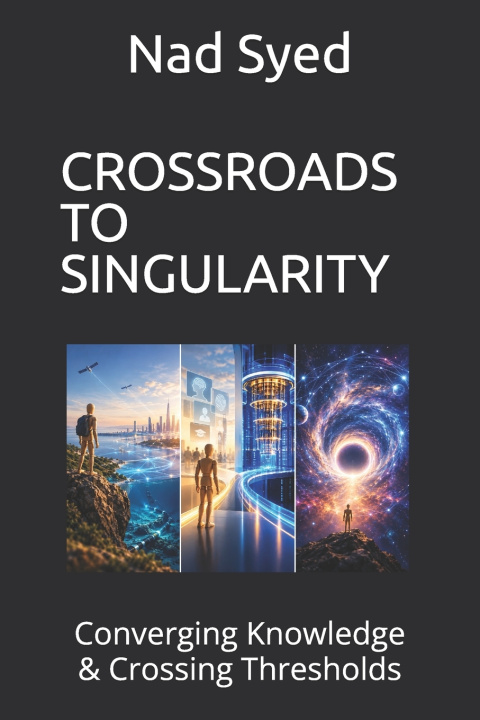
Crossroads to Singularity explores nine interconnected roads, and how each appears to have accelerated into the next-Connection, Knowledge, Intelligence, Mind, Awareness, Crowd, Capability, Consequence, and Convergence.
Among the questions it follows:
- Why does today's most advanced AI exchange data along routes laid down in the Victorian telegraph era?
- What did online gamers solve in three weeks that experts had not solved in over a decade?
- Why does physics still run on two rulebooks that do not work in each other's domain?
- Could we cross the most consequential threshold of all without ever detecting it?
In the Field scenarios run alongside-power grids, markets, orbit, ports, hospitals, and the phone in your hand.
Written for the curious reader, the reflective thinker, and the young professional, this book requires no specialized background in science, technology, or economics. It may also appeal to academics from non-science backgrounds seeking an accessible view of the ideas and trends shaping our world.
It ends with
the Crossroads Check: seven questions to carry into a world moving faster than anyone can deliberate.
The map is drawn. The crossroads is here. The next step is ours.