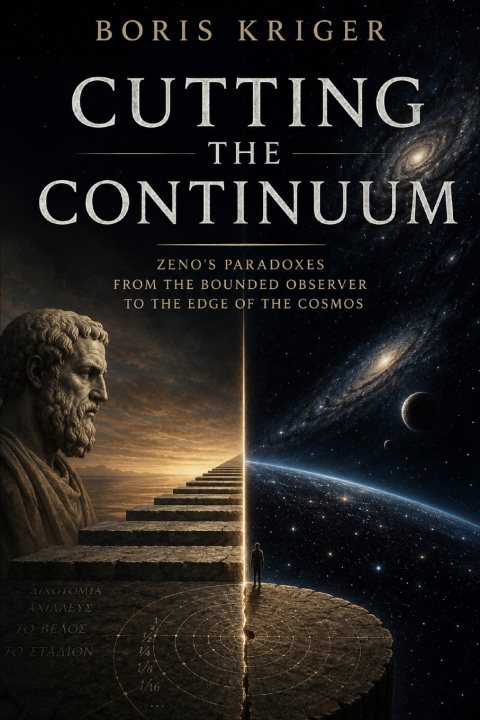
For twenty-four centuries a stubborn Greek has been telling us that motion is impossible, and no one has quite managed to prove him wrong.
Achilles can never catch the tortoise. The arrow in flight is, at every instant, perfectly still. To cross a room you must first cross half of it, and then half of what remains, and then half of that, without end. These are the paradoxes of Zeno of Elea, and the quietly embarrassing truth is that the standard replies to them, from Aristotle through the calculus to Cantor, defeat the arithmetic while leaving the wound untouched. The runner still seems to move. The uneasiness never quite goes away.
This book locates the wound. Zeno did not make a mathematical mistake. He made an ontological one. He took the instruments the human mind uses to compress and model reality, the point, the instant, the endlessly divisible line, the frozen snapshot of a flying arrow, and mistook them for features of the world itself. He never separated the observer from the physics he was describing. He made the measuring mind into the measure of all things, and the whole of Western thought inherited the confusion without noticing it had been handed one.
Reading the paradoxes through a unified structural theory of complex systems, Cutting the Continuum climbs a single spiral. It begins in the marketplace of Elea. It descends into the architecture of the bounded observer, the mind that cannot contain itself, that never perceives the present, that reconstructs time rather than reading it off a clock. It rises through the physics of persistence, where nothing that sits perfectly still can survive and motion turns out to be the very condition of existing at all. And it ascends at last to the edge of the cosmos, where the ancient quarrel between the One and the Many is reopened at the scale of the universe, and where we finally ask whether reality itself takes discrete steps.
The arrow never froze. It was always the mind that blinked. Here, at last, is what Zeno was really pointing at.
Keywords: Zeno's paradoxes, philosophy of physics, continuity and discreteness, consciousness and time, cosmology, bounded observers, persistence