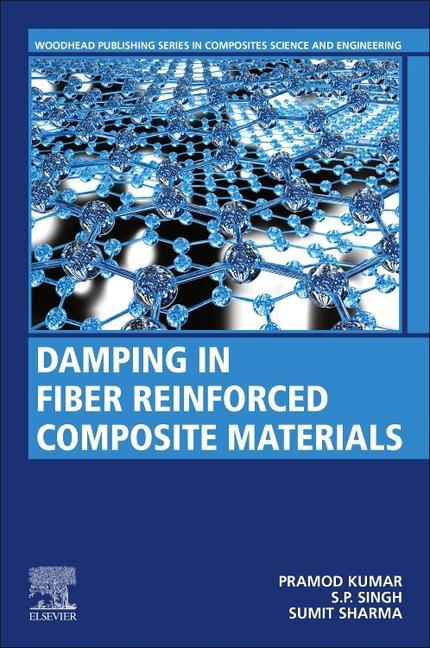
Könyv Damping in Fiber Reinforced Composite Materials Pramod Kumar

Damping in Fiber Reinforced Composite Materials

Nyelv: Angol
Kötés: Puha kötésű
Elérhetőség: Beszállítói készleten
Küldés 10-18 napon belül
72 807 Ft
Damping is an important parameter that is used for measuring and predicting the dynamic performance...

Információk a könyvről

Nyelv
Angol
Kötés
Könyv - Puha kötésű
Kiadva
2023
oldal
166
EAN
9780323911863
Enbook ID
37352134
Súly
290
Méretek
152 x 229

Teljes leírás

Damping is an important parameter that is used for measuring and predicting the dynamic performance of composite materials. In this exemplary new book, the authors discuss damping behaviour in glass fiber-reinforced composite materials. Damping in Fiber Reinforced Composite Materials starts with an introduction to the basic concepts of damping in composite materials. Methods of modelling damping are then discussed in chapter two. These include both macro and micro-mechanical approaches. Chapter three then goes on to discuss recent developments in measuring techniques, both local like polar scanning and global techniques like the Resonalyser method (based on measuring modal damping ratios of composite material plates). The effect of other factors such as stress, strain-level, stiffness and frequency that need to be considered when determining damping behaviour in composite materials are also discussed in detail. In chapter four a parametric study of a two-phase composite material is presented using different micromechanical models such as Unified micromechanics, and Hashin, and Eshelby’s to predict elastic moduli and loss factors. A bridging model that incorporates the effect of fiber packaging factors is then compared to FEM results. Chapter five investigates the effect of the interphase on the mechanical properties of the composite. A mathematical model is developed for prediction of elastic moduli of a three-phase fiber reinforced composite. Chapter six presents a nonlinear model for the prediction of damping in viscoelastic materials. The final chapter provides practical examples of damping and discusses principles of vibration control. The book will be an essential reference resource for academic and industrial researchers working in the field of composite materials, especially on the modelling and analysis of damping and dynamic behaviour. Introduces the basics of damping and dynamic analysis in composite materials Explains damping mechanisms in fiber reinforced composites and modelling principles Covers recent developments in measuring techniques for identification of damping in composite materials Explains the use of a dynamic mechanical analyser for predicting damping in composite materials Contains micromechanical studies, modelling of two and three-phase composites and modelling of non-linear damping Experimental results are also included to validate micromechanical models

Érdekelheti

49 256 Ft
4 504 Ft
4 270 Ft
4 825 Ft

Coastal Fluxes in the Anthropocene

Christopher J. Crossland
58 960 Ft

Ramayana

R K Narayan
4 431 Ft
9 169 Ft
20 880 Ft
15 560 Ft

Azok a vásárlók, akik ezt a könyvet megvásárolták, a következőket is megvásárolták