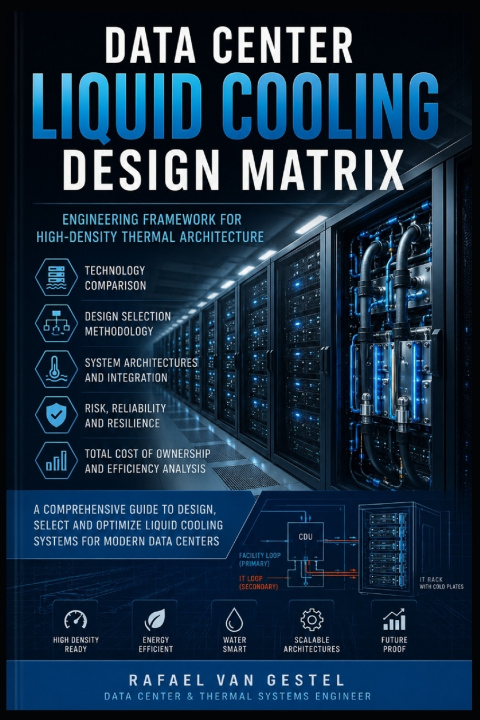
The rapid evolution of digital infrastructure has pushed data centers beyond the thermal and energy limits of traditional air cooling. As computer densities increase, driven by AI workloads, high-performance computing, and accelerated processors, liquid cooling is no longer an alternative-it is becoming a design necessity.
This Data Center Liquid Cooling Design Matrix is created as a structured decision framework to help engineers, designers, operators, and stakeholders evaluate, compare, and implement liquid-based thermal management strategies with clarity and technical rigor. It is not a theoretical overview; it is a practical engineering reference intended to bridge the gap between concept and implementation.
Liquid cooling is not a single technology but a spectrum of architectures, including direct-to-chip cooling, rear-door heat exchangers, immersion systems, and hybrid air-liquid configurations. Each solution carries its own implications on hydraulics, heat rejection, redundancy, maintainability, water quality, energy efficiency, and capital cost. The challenge is not only selecting a system, but aligning it with workload profiles, resilience requirements, and facility constraints.
This matrix organizes these variables into a comparative structure that supports informed decision-making across multiple dimensions:
- Thermal performance and heat flux capability
- Energy efficiency and PUE impact
- Water usage effectiveness and sustainability constraints
- Integration with existing HVAC and BMS infrastructure
- Scalability for future high-density computing
- Operational complexity and maintenance accessibility
- Risk, redundancy, and failure mode considerations
The intent is to provide a system-level lens, rather than component-level analysis, enabling better alignment between IT architecture and mechanical engineering design. In modern data centers, cooling is no longer a support function-it is a core enabler of compute performance and business continuity.
As the industry transitions toward AI-driven infrastructures and megawatt-scale racks, liquid cooling design will define not only efficiency, but feasibility. This document serves as a structured guide to navigate that transition with engineering precision and strategic foresight.