Decision-makers do not fund vague concerns. They fund numbers they can compare, track, and defend.
Thermal problems in a data center rarely announce themselves as a single dramatic failure. More often they accumulate quietly - a rack that runs a few degrees warmer than its neighbors, a CRAH unit operating at reduced capacity, a blanking panel left off during a service call, a leak detection cable that has never been tested since commissioning. Individually, each of these looks minor. Collectively, they determine whether a facility survives a hot summer afternoon with an N+1 cooling train down for maintenance, or trips into thermal runaway.
The problem facility managers face is not a lack of awareness that these risks exist - it is the lack of a common language to compare them. Is a 4°F hot spot in Row 12 more urgent than a UPS-cooling single point of failure in the electrical room? Is an aging leak-detection sensor a bigger priority than adding CRAH redundancy in a high-density pod? Without a shared scoring method, these questions get answered by whoever argues loudest in the capital planning meeting, not by the data.
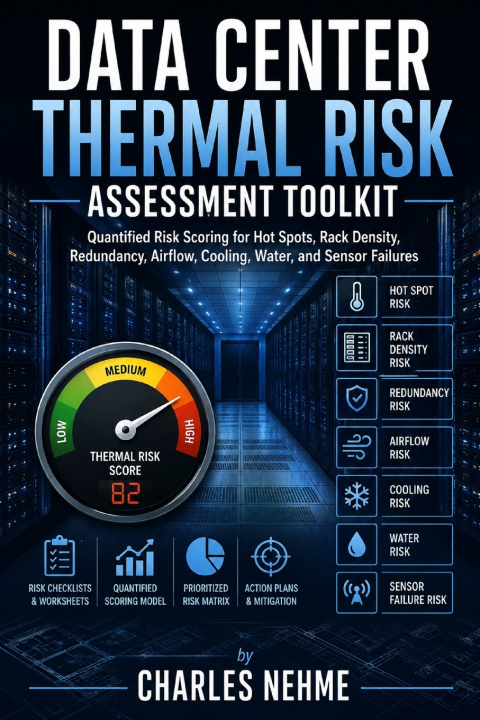
This toolkit exists to close that gap. It applies a single, consistent quantitative framework - built on Failure Mode and Effects Analysis (FMEA), Risk Priority Number (RPN) scoring, and weighted risk matrices - across seven categories of data center thermal risk: hot spots, rack density, redundancy failures, airflow restrictions, cooling failures, water failures, and sensor failures. Every category uses the same scoring scale, the same RAG (Red-Amber-Green) visual language, and the same worksheet structure, so scores from a cooling audit can be compared directly against scores from an electrical risk register or a leak-detection review.