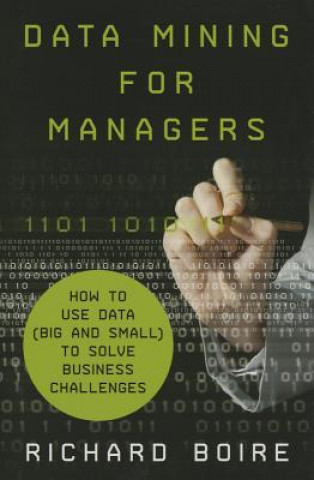
Könyv Data Mining for Managers Richard Boire

Data Mining for Managers

Szerző: Richard Boire
Nyelv: Angol
Kötés: Kemény kötésű
Elérhetőség: 50 % esély
Keressük az egész világon
19 802 Ft
The purpose of the book is to provide insights and knowledge which can be actioned by both business...


Információk a könyvről

Szerző
Nyelv
Angol
Kötés
Könyv - Kemény kötésű
Kiadva
2014
oldal
242
EAN
9781137406170
ISBN
1137406178
Enbook ID
04771863
Súly
544
Méretek
238 x 159 x 23

Teljes leírás

The purpose of the book is to provide insights and knowledge which can be actioned by both business people who are end users of data mining, as well as the hands-on data mining practitioner. The perspective here will focus on the actual business practice of data mining, as the author has over 30 years of experience in this area. Data Mining for Managers is organized along the four-step process which is the approach used in undertaking any data mining project. These four steps are: 1) Identification of the Business Problem/Challenge 2) Creation of the Analytical Environment 3) Application of Data Mining Tools 4) Implementation and Measurement/Tracking Not all business problems require solutions that can be built using data mining. Yet, the intention of the book is to help the reader develop a perspective that better enables him or her to identify issues that relate to data mining. Once data mining is identified as the key discipline to solve a given business problem, the book conveys how the data mining process should be undertaken to solve a given business problem. Within each step, the practitioner will be shown specific things they need to consider when building solutions. At the same time, the business users will be shown what things they need to look at in terms of results and output from data mining but more importantly how to interpret results into actionable learning. Although the overall flow of the book will stem from the above 4-step process, specific topics such as conducting business sensitivity analysis to determine the viability of certain initiatives as well as customer segmentation will be explored. Data Mining for Managers does not attempt to convert all readers into data mining specialists. Instead, it makes data mining accessible and comprehensible to a wide audience. The book provides a good starting point for those just beginning to explore data mining but is also complex enough to be extremely useful to a more seasoned miner. Brahm focuses on imparting insights and knowledge related to data mining strategy. He demonstrates, through case studies and casual anecdotal evidence, how his strategies that can shift the key levers of your business-and drive ROI. Although data mining technology is becoming more sophisticated and complex in terms of providing additional targeting capabilities, no one-Brahm asserts-should doubt that there will always be an element of artistry-of business and intellectual understanding-to building data mining solutions. Brahm demonstrates how a clear understanding of data without any deeper understanding of what could be driving the results will generate potentially misleading conclusions and recommendations. He engagingly outlines methods for combining technological expertise with a conceptual vision and understanding of the business in order to achieve optimal results. Data Mining for Managers advises managers about the investment in intellectual capital required for effective data mining. In fact, Brahm states, successful organizations will prioritize their investment on the intellectual side rather than on the technological front. The book uses various case studies to illustrate its message, including this one about American Express: AMEX built conceptualized and constructed models that would allow the company to predict net response as well as profitability. This allowed the Amex marketing team to select prospects not only on ROI but also on net response (as one of their key performance measures was cards in force). In effect the use of this decision tool allowed marketers to demonstrate the impact of optimizing ROI versus lost cards opportunity. This case study demonstrates how an organization evolved their overall acquisition strategy based on data mining.

Érdekelheti

Crisis Without End?

Andrew Gamble
39 152 Ft
3 196 Ft
40 743 Ft
36 198 Ft

Asininity Expose

Bobby Nelson
5 245 Ft

Bulletin of the United States Bureau of Fisheries

United States Bureau of Fisheries
15 938 Ft

Without a Doubt

NANCY COL SILVERMAN
9 298 Ft
7 052 Ft

Tamarind Mem

Malika Mendez
8 289 Ft

God Hath Spoken

Harris Dark
12 441 Ft

Mid-Strut

ERIC BURNS
5 671 Ft
6 254 Ft

Out of the Woods

E. Christopher Clark
3 838 Ft

Africanismo

Charles Olusegun Doherty
1 578 Ft

Thank You, Everything

Emilie Robert Wong
8 742 Ft

Azok a vásárlók, akik ezt a könyvet megvásárolták, a következőket is megvásárolták