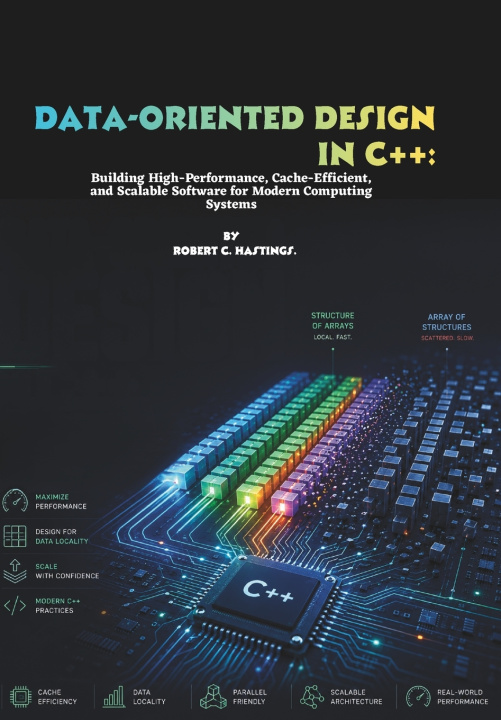
Modern CPUs are starving. While processor speeds have soared, memory access times barely crawl. Data-Oriented Design (DOD) is a paradigm that treats memory layout and hardware architecture as the ultimate drivers of performance. It abandons traditional Object-Oriented deep inheritance and fragmented memory in favor of flat, contiguous data streams. By aligning your code with the physical reality of the CPU cache, DOD unlocks the blistering throughput of modern silicon.
For years, I wrote what I thought was "perfect" C++ code. I mastered deep inheritance trees and meticulously encapsulated objects. My architecture diagrams were beautiful. But when I ran the profiler on heavy data loads, the performance was completely suffocating.
Why?
I realized I was writing code for other humans, not the machine. Every virtual function was a pipeline stall. Every scattered object was a cache miss. I was forcing a hyper-advanced CPU to wait on fragmented memory. The day I discovered Data-Oriented Design and began treating memory as raw, contiguous data blocks, everything changed. Execution times plummeted, latency dropped, and maintenance actually became easier. You have likely hit this exact same performance wall in your own projects. Now, it is time for you to break through it.
What's inside- The Hardware Reality: A brutal, easy-to-understand breakdown of L1/L2 caches, false sharing, and branch prediction.
- The OOP Takedown: Why standard node-based containers (like std::list) silently kill your software.
- The DOD Playbook: Step-by-step guides to implementing Structure of Arrays (SoA) and flat architectures.
- Silicon Auditing: Reading Flame Graphs and using assembly outputs to verify auto-vectorization.
- Real-World Cases: Refactoring game physics, High-Frequency Trading algorithms, and Big Data pipelines.
Who it's meant for- C++ Engineers tired of unexplained performance bottlenecks.
- Game Developers squeezing every millisecond out of simulation loops.
- Systems Architects building ultra-low latency financial or data-ingestion pipelines.
- Anyone wanting to stop guessing and start engineering with absolute mechanical sympathy.
The hardware is waiting. Are you going to keep starving your processor with fragmented objects, or are you ready to unleash its true potential? Stop writing code for compilers. Start writing code for silicon.
Grab your copy today, and transform the way you engineer software forever!