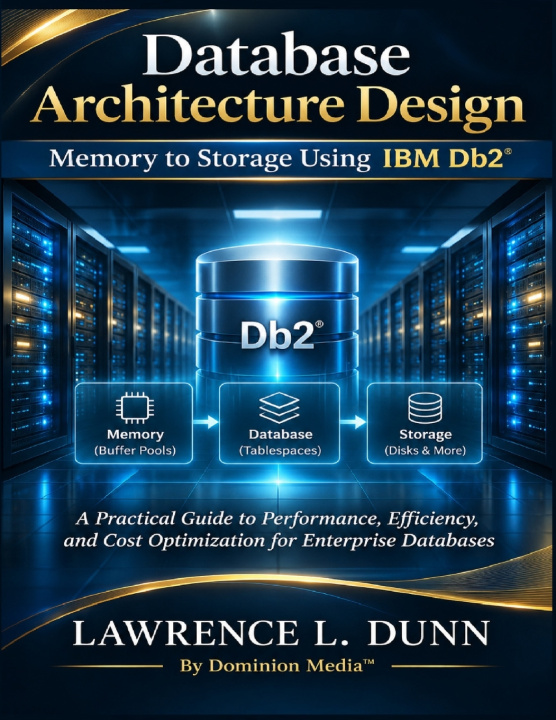
Stop Buying More Infrastructure. Start Designing Better Databases.
Is your organization spending millions on database infrastructure when better architecture could deliver greater performance at a fraction of the cost?
In Database Architecture Design: Memory to Storage Using IBM Db2, veteran Data Architect Lawrence L. Dunn draws upon more than 30 years of enterprise technology consulting experience to demonstrate how intelligent database architecture can improve performance, reduce unnecessary infrastructure expenditures, and increase business profitability.
Having worked with organizations including IBM, Procter & Gamble, Kroger, Walgreens, LexisNexis, and the Department of Defense, Dunn understands the challenges of designing and maintaining large-scale enterprise repositories.
His central argument is simple: Database performance begins with architecture, not hardware purchases.
What You'll Learn
This practical guide explores the critical relationships between applications, database memory, and physical storage, including:
IBM Db2 Buffer Pool Optimization: Improve memory utilization, reduce physical I/O, and accelerate data retrieval.
Application-Driven Database Architecture: Design repositories around actual business workloads rather than arbitrary technical configurations.
Tablespace Design and Management: Understand page sizes, tablespace organization, and their effects on performance.
Database Prefetching: Improve data access efficiency through intelligent prefetch strategies.
Automatic Memory Management: Evaluate Db2 memory-management capabilities for changing workloads.
Database Storage Optimization: Reduce unnecessary storage consumption and improve infrastructure efficiency.
AI-Assisted Database Management: Use artificial intelligence for performance analysis, anomaly detection, predictive capacity planning, and optimization recommendations.
180-Day Implementation Roadmap: Apply a structured approach to architectural assessment, optimization, AI integration, and financial accountability.
Real Experience. Real Financial Results.
During his career, Dunn participated in a capacity-planning initiative at Procter & Gamble that identified an opportunity to consolidate three IBM 3090 mainframes into two, generating approximately $2 million in annual savings.
The lesson? Organizations do not always need additional computing resources. They need to understand how efficiently their existing resources are being used.
Artificial Intelligence Meets Enterprise Database Architecture
Many of the database optimization techniques discussed in this book have existed for decades. Yet businesses continue to experience inefficient repositories, excessive infrastructure costs, and preventable performance problems.
Artificial intelligence offers an opportunity to transform database management by helping professionals analyze complex workloads, identify inefficiencies, forecast resource requirements, and make better-informed architectural decisions.
However, AI cannot replace competent technical leadership, experienced database architects, or sound engineering judgment.
AI amplifies expertise. It does not replace it.
Improve database performance. Optimize memory and storage. Reduce infrastructure costs. Harness artificial intelligence. Increase profitability.
Your next major performance improvement may not require another hardware purchase. It may require a better database design.