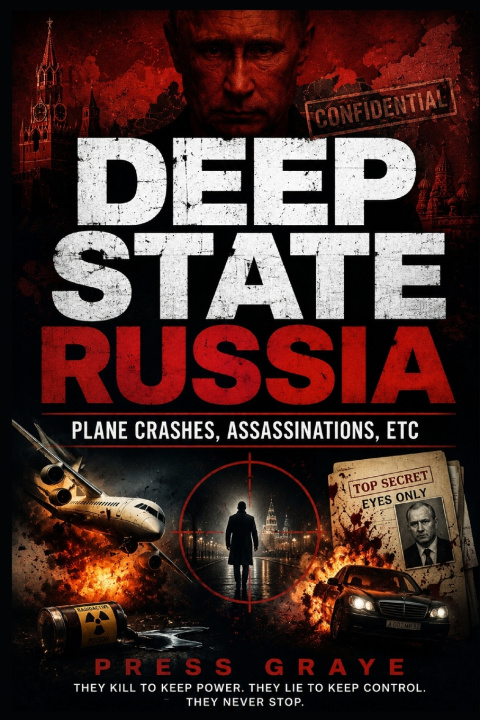
In Russia, death is rarely just death when it happens near power.
From Soviet-era assassinations to modern poisonings, prison deaths, suspicious falls, plane crashes, and wartime car bombings, Deep State Russia follows a dark trail of bodies connected to the Russian state, its enemies, its defectors, its critics, and its own insiders.
This book examines some of the most chilling deaths tied to Russia's political world: Leon Trotsky, Georgi Markov, Alexander Litvinenko, Anna Politkovskaya, Sergei Magnitsky, Boris Nemtsov, Alexei Navalny, Yevgeny Prigozhin, and many others. Some cases were proven assassinations. Some were blamed on illness, suicide, accident, or mechanical failure. Others remain trapped in the gray zone between official explanation and political suspicion.
But when the same kinds of people keep dying in the same kinds of strange ways, the pattern becomes impossible to ignore.
Deep State Russia is not written as a dry history lesson. It reads like an investigative dossier, moving case by case through the old Soviet playbook, the rise of Putin-era political deaths, the danger faced by exiles abroad, the suspicious deaths of businessmen and insiders, and the new phase of wartime violence reaching back into Moscow itself.
Inside, this book explores:
The old Soviet assassination methods that used bombs, poison, and deception.
The Putin-era critics who died after exposing corruption, war crimes, intelligence abuse, and state power.
The exiles who believed foreign countries could protect them, only to discover that distance does not always close the file.
The oligarchs, businessmen, and energy figures whose deaths raised questions during moments of political and financial pressure.
The plane crash that killed Wagner chief Yevgeny Prigozhin after his failed mutiny against Moscow.
The way terrorism, war, and internal threats helped expand Putin's power domain.
This is a book about more than death. It is about control, fear, silence, and the political usefulness of uncertainty. In Russia's death file, the official cause of death may tell you how a body stopped breathing - but it does not always tell you why that person, in that place, at that time, ended up dead.
Deep State Russia asks the question that official statements often avoid:
When power benefits from the silence, can the death ever really be called an accident?