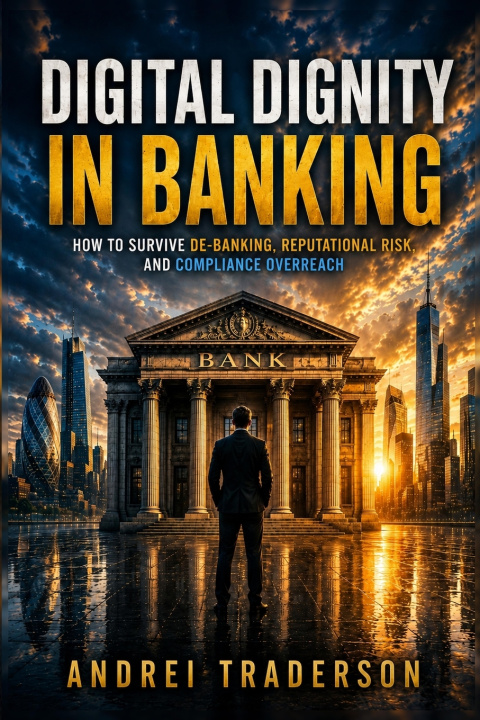
A bank account has become far more than a place to store money.
Today, it represents access to salaries, suppliers, mortgages, investments, international payments, and participation in the global financial system. Yet around the world, individuals, entrepreneurs, charities, fintech companies, and legitimate businesses are increasingly discovering that access to banking can be restricted, delayed, or withdrawn - not because wrongdoing has been proven, but because risk has become difficult to explain.
Digital Dignity in Banking explores one of the most important transformations in modern finance: the rise of compliance as a defining force in everyday banking.
Written in a clear, practical, and engaging style, this book examines how anti-money laundering rules, sanctions compliance, customer due diligence, reputational risk, automated monitoring systems, and regulatory expectations have reshaped the relationship between financial institutions and their customers.
Inside, readers will explore:
• Why modern banks have become gatekeepers of financial access
• How AML transformed the role of bankers and compliance professionals
• The growing impact of reputational risk on banking decisions
• Why legitimate customers sometimes face de-banking or account restrictions
• How algorithms, transaction monitoring, and artificial intelligence influence financial decisions
• The challenges faced by charities, entrepreneurs, fintech firms, politically exposed persons, and international businesses
• The balance between financial crime prevention and fair access to banking services
• Practical ways individuals and businesses can strengthen their banking profile before problems arise
• The future of trust, transparency, and accountability in an increasingly digital financial system
Rather than portraying banks as villains or customers as victims, this book explains the difficult reality facing both sides. Financial institutions must protect themselves against money laundering, sanctions breaches, fraud, corruption, terrorist financing, and regulatory enforcement, while customers increasingly find themselves expected to prove not only who they are, but also that every aspect of their financial story can withstand institutional scrutiny.
Whether you are a banker, compliance professional, lawyer, accountant, business owner, fintech entrepreneur, student, regulator, or simply someone who wants to understand how modern banking really works, Digital Dignity in Banking provides valuable insight into one of the defining financial issues of our time.
Modern banking is no longer built solely on trust.
It is built on explainability and understanding that change may be one of the most important financial skills of the twenty-first century.